
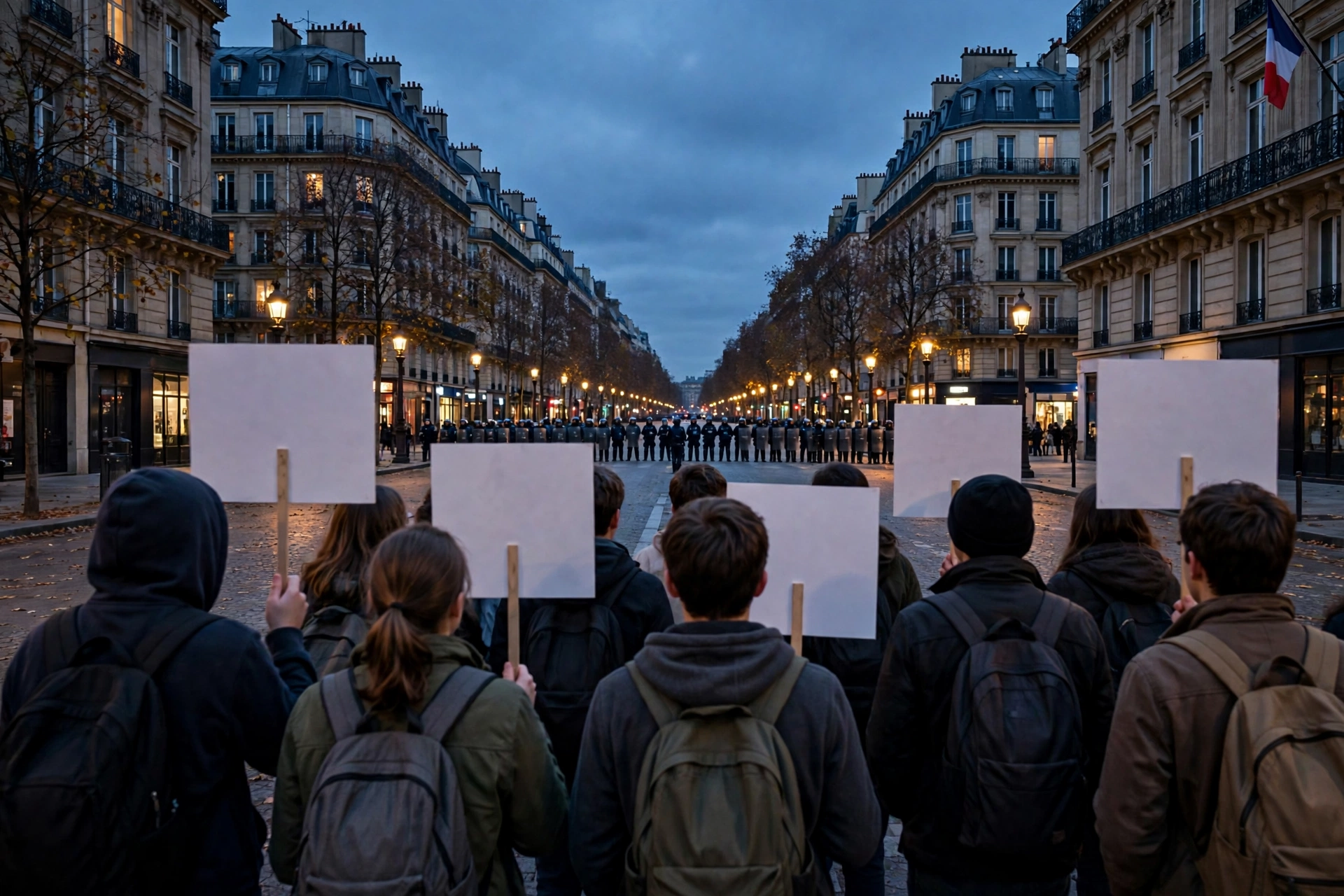
PARIS, France.- French student unions will escalate their protest movement next week with new blockades of high schools and universities on Tuesday and again on Thursday, before joining a larger demonstration on November 5 called by workers and trade unions.
The announcement came from Sabrine Kharbach, spokesperson for the Union Étudiante, speaking during Saturday's authorized march in eastern Paris. "Starting this Tuesday, we will blockade our universities and high schools, and we will do so again on Thursday before joining the demonstration on November 5 called by workers and trade unions," Kharbach said, according to reports of her remarks.
Saturday marked the third consecutive weekend of nationwide protests in France. The Interior Ministry counted about 320,000 demonstrators across the country, including 70,000 in Paris, while the youth unions behind the marches claimed nearly 500,000 nationwide and about 200,000 in Paris. About 70,000 police officers and gendarmes were deployed, and by 9:00 p.m. police had made 565 arrests, fewer than the roughly 1,000 reported a week earlier.
From school conditions to the cost of living
What began as student protests over deteriorating school conditions has broadened into a wider movement over the cost of living, inequality and police violence, bringing together high school and university students, trade unions and Yellow Vest activists. Student leaders say the government's education package, unveiled on October 26, is not enough: it offered about 5 billion euros in interest-subsidized loans for school and university renovations, caps on class sizes and reforms to the Parcoursup university admissions platform, but students rejected it as insufficient.
Manon Moret, secretary-general of the National Union of French Students (UNEF), said the government has yet to provide a concrete response to young people's demands. Hard-left presidential candidate Jean-Luc Mélenchon joined the Paris march and accused President Emmanuel Macron's government of taking an "increasingly authoritarian" turn.
The unrest comes with presidential elections less than six months away, with far-right leader Marine Le Pen leading opinion polls, and with France's economy under pressure from high debt and a risk of recession, leaving the government limited room to answer protesters with new spending.
Fuentes: TRT World, Newstalk ZB y Pragativadi, 31 de octubre de 2026.