
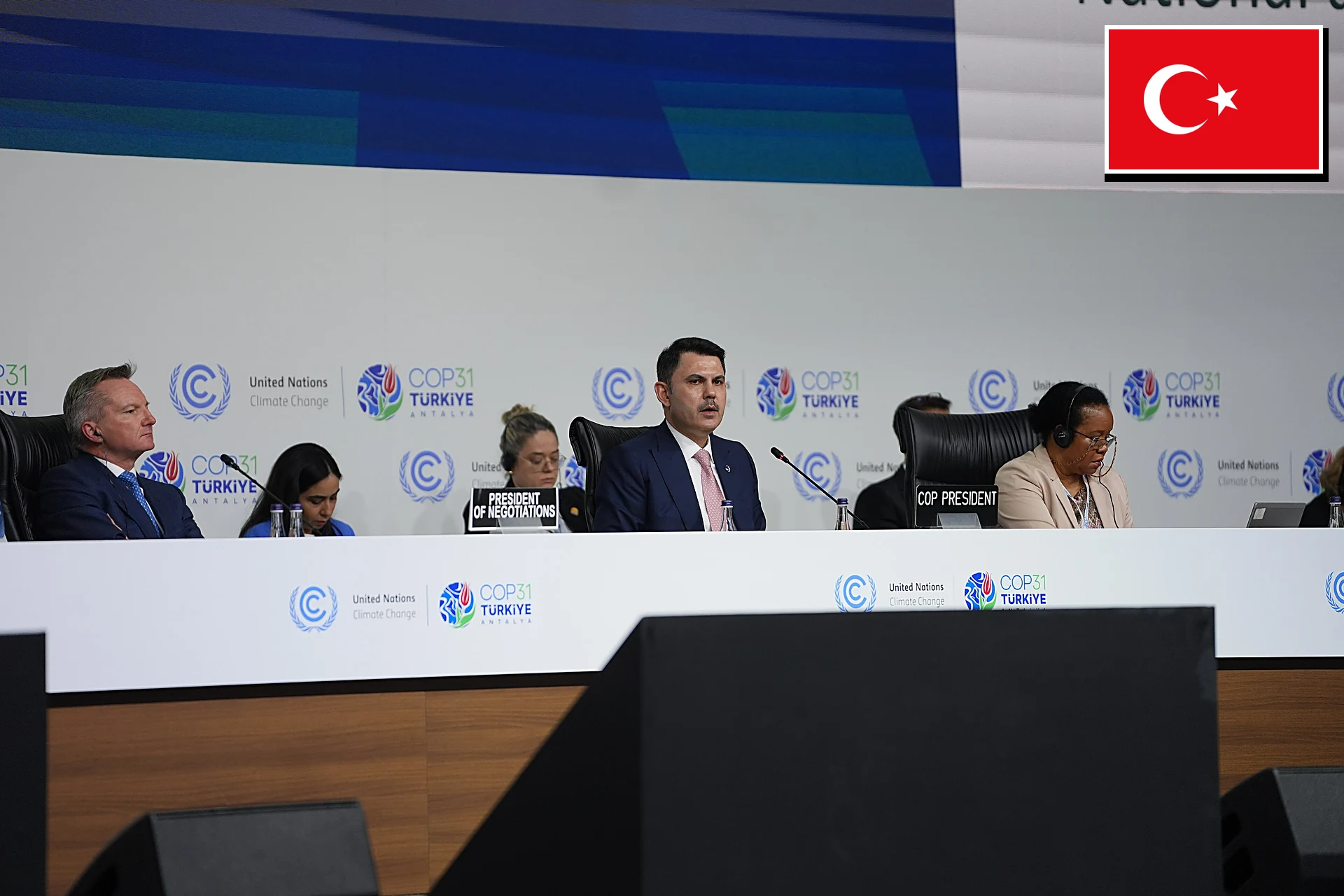
The COP31 presidency put its final deal before the world's governments in the early hours of Sunday, 22 November — a ten-page package that never once mentions fossil fuels, the chief cause of global warming, and now faces a vote in Antalya, Türkiye, after two days of overtime. The text, presented by COP31 President Murat Kurum as a consensus deal, recalls the 2023 Dubai agreement in its very first line but does not contain the words "fossil", "oil", "coal" or "phase out" anywhere in its 94 paragraphs, the Associated Press reported.
"We believe that we have put forward a text which all the parties can agree upon," Kurum told a late-night plenary session, Rappler reported. Delegations were given until 03:00 GMT to lodge objections, with the approval session due on Sunday morning. The presidency said it aimed to bring the text to the plenary at 10:00–10:30 local time (07:00–07:30 GMT), though at least one report said the session had slipped later in the morning. Approval needs near-unanimous consensus, and a single formal objection can stop a deal.
What the package offers instead
The text's single headline energy goal is to raise electricity's share of total final energy consumption from about 21 per cent today to 35 per cent by 2035 — a target backed by some 90 countries and championed by Türkiye as its signature contribution to the summit, The Curtain reported. But the goal carries no requirement that the additional electricity come from renewable sources, so power generated by burning coal and gas could count towards it.
"Electrification that runs on coal and gas does not limit warming," said Bill Hare, chief executive of Climate Analytics. "Continued reliance on coal and gas risks shifting where fossil fuels are burned and locking in further emissions." Türkiye and the head of the International Energy Agency have argued that, because about 80 per cent of new electricity is fuelled by renewables, the goal will cut emissions just the same, the Associated Press reported.
The package also sets a goal to scale up carbon capture, utilisation and storage to gigatonne scale — one billion metric tons — by 2035, framed as a collective global aspiration. The technology is backed by the oil industry and criticised by several delegations as expensive and unproven at scale. On finance, the commitment to triple adaptation finance by 2035 is reaffirmed, but with no explicit baseline against which the tripling would be measured and no details on how it would be calculated. An earlier draft's proposed target of $120 billion a year in adaptation finance for developing countries by 2035 was dropped.
The text would also be the first COP outcome to acknowledge that the world will overshoot the 1.5°C limit set by the Paris Agreement, calling for any overshoot to be kept "as small and short as possible". The science makes the admission hard to avoid: October 2026 was 1.8°C warmer than the mid-1800s, according to Berkeley Earth, and the hottest October on record.
The package launches an Antalya-to-Addis Ababa Roadmap, co-led by Türkiye and COP32 host Ethiopia, to map predictable finance sources for adaptation and loss and damage ahead of the next summit in Addis Ababa in November 2027.
The objections, and the risk of no deal at all
The draft is the product of a fortnight of deadlock over one question: whether the final agreement should name the cause of global warming at all. An earlier draft, published on Thursday, stripped out every reference to moving away from fossil fuels after objections from Saudi Arabia and other major oil and gas producers, and dropped the $120 billion adaptation target. The new text refines that draft rather than reversing it.
Panama's environment minister, Juan Carlos Navarro, had vowed to formally object to any agreement that failed to cap oil production, accusing the talks of being held hostage by a "petroleum mafia". The European Union's climate commissioner, Wopke Hoekstra, said on Saturday that the summit should produce a good deal or no deal at all. Germany and the EU have signalled uncertainty about approving the draft, and an EU source warned there is a real possibility COP31 could finish without an agreed outcome.
Environmental group 350.org said it was disappointed by the draft's failure to mention fossil fuels explicitly, as well as its encouragement of carbon-removal technologies. "Carbon capture is one of the biggest scams of the overshoot era, and our leaders are on the verge of falling for it," said Sara Shaw, the group's campaigns and networks director. She said the draft deal opens the door to more fossil fuel development. Observers said Saudi Arabia and other big oil-producer nations had pushed hard in negotiations for keeping fossil fuels out of the text, and carbon removal in; a representative for the Saudi delegation declined to comment.
Alden Meyer, a longtime analyst with the think tank E3G, noted that fossil fuels went unmentioned in final COP decisions for more than 25 years before Dubai — and warned that coming out of Antalya "with no signal that we were serious about what we agreed to do three years ago" would be a real setback.
There is also a practical worry: as negotiators depart, organisers fear the conference may struggle to muster the two-thirds quorum of delegates needed to pass the draft at all. The United States, the world's largest historical emitter, is absent for a second consecutive year, after President Donald Trump ended cooperation with the process and called global warming a hoax.
Two weeks that ran two days over
COP31, co-hosted by Türkiye and Australia and attended by delegations from nearly 200 countries, was scheduled to end on Friday, 20 November. Instead, negotiators worked through Saturday and into the small hours of Sunday. The closing plenary was suspended at 10:29 p.m. local time on Friday amid the deadlock, resumed, and ran into the night again on Saturday before Kurum tabled the final text.
This year is the first COP since the UN's environmental body confirmed that the rise in global temperature was set to blow past 1.5 degrees, a threshold all countries agreed over a decade ago to try not to exceed. In his farewell address to the summit, UN Secretary-General António Guterres warned: "You cannot build peace on a burning planet."
What is still unknown
At the time of publication, the plenary had not yet voted on the text, and the document could still be amended before adoption. It is not yet known whether Panama or any other country will lodge a formal objection, whether the EU and the coalition that demanded explicit fossil-fuel language will accept the compromise, or whether enough delegates will remain in Antalya to reach quorum. If the text is adopted, COP31 will be remembered as the summit that admitted defeat on 1.5°C and built its energy future on electrification without naming the fuels it must replace. If it is blocked, Antalya will join the short list of summits that ended with no agreement at all, the first since 2000.
Lee también: Europe's Deadliest Summer: Heat Killed an Estimated 50,000 People in Cities, Study Finds, Cyclone Murasu Smashes Into Andhra Pradesh Near Ongole With 120 km/h Gusts, Flooding Crops and Cutting Power y Flooding Moves Election Day Polling Places Across the Navajo Nation as Southwest Storms Threaten Tribal Voters.
Fuentes: Associated Press, 22 de noviembre de 2026; Rappler, 22 de noviembre de 2026; The Curtain, 22 de noviembre de 2026; CarrZee, 22 de noviembre de 2026; Daily Star, 22 de noviembre de 2026; texto oficial de la decisión de portada, símbolo DT.CMA8.i2c.1 (UNFCCC). Portada: el presidente de la COP31, Murat Kurum (centro), y el presidente de negociaciones, Chris Bowen (izquierda), en la plenaria de clausura en Antalya, 20 de noviembre de 2026 — foto de Xuthoria, CC BY-SA 4.0, vía Wikimedia Commons; bandera de Türkiye (dominio público, vía Wikimedia Commons).
UPDATE — 22 November, 07:25 Bogotá time (12:25 UTC): COP31 has collapsed without an agreement. At the closing plenary on Sunday, COP31 President Murat Kurum acknowledged that there was no consensus and that the decisions were not adopted: “It is clear that there are parties in this hall who oppose this text. We recognise that there is no consensus on this document. Therefore, these decisions have not been adopted,” Ynet reported. The European Union formally objected to the final text. Darragh O’Brien, Ireland’s climate and energy minister, speaking for the EU, which holds the rotating presidency, said: “We will not endorse a cover decision, or an Antalya Pact, that does not even mention fossil fuels, which is the key driver of climate change,” and added that the EU “will not accept a COP that greenwashes fossil fuel,” Agence France-Presse reported. Panama also formally objected to the deal. The Marshall Islands delegation said it had “been let down on all sides” and would “not compromise our future to benefit fossil fuel interests,” while Russia’s delegate said his country could not agree to any formulation on fossil fuel, Reuters reported. It is the first COP to close without an agreement since the Hague talks in 2000, and one of the most significant failures of climate diplomacy since the 2009 Copenhagen summit, when countries also failed to adopt an accord by consensus. The collapse does not undo the commitments made at previous summits, and the technical decisions on carbon markets adopted on Friday stand.
UPDATE — 22 November, 08:27 Bogotá time (13:27 UTC): The backlash to the collapse kept growing on Sunday. The United Kingdom formally objected to the draft deal. Energy Secretary Miatta Fahnbulleh called the failure “immensely disappointing” and said the government “does not believe the cover decision proposed by the presidencies meets the moment,” adding that it “moves us backwards on the science when we must accelerate implementation,” the Press Association reported. Britain said it was “ready to return to Cop32 in Addis Ababa with advances made, even stronger resolve and an improved Cop process.” The European Union’s representative argued the draft had been “hijacked” by oil states. The summit ran more than 44 hours beyond its scheduled conclusion before closing without agreement. Attention now turns to COP32, confirmed for Addis Ababa from November 8 to 19, 2027, with Ethiopia’s Foreign Minister Gedion Timothewos as president-designate, who said his country was ready to take the negotiations forward “as a relay in which each host builds on the work of its predecessor,” Times Kuwait reported. For Africa, the summit still delivered process, if not money: a standalone Climate Finance Work Programme — a key demand of developing countries — and a request that the Standing Committee on Finance prepare a technical report on baseline options and progress toward tripling adaptation finance. African negotiators did not get the dedicated agenda item on tripling adaptation finance they sought; the African Group of Negotiators’ chair, Dr Antwi Amoah of Ghana, confirmed it was not adopted. The scale of the gap: public adaptation finance grew by only US$1 billion between 2023 and 2024, against needs of about US$305 billion a year, while Africa’s own adaptation needs are estimated at around US$70 billion a year, Modern Ghana reported.
UPDATE — 22 November, 09:30 Bogotá time (14:30 UTC): The closing plenary ended in open failure on Sunday. COP31 President Murat Kurum told delegates, “There is nothing to do, we did all that we could,” and added, “There will be no new text from now on,” before leaving the stage while country representatives were still speaking, Reuters reported. Australia’s COP31 President of Negotiations, Chris Bowen, called the outcome “very disappointing” and said disagreements over fuels and climate finance were the dealbreakers. The summit, which ran more than two days into overtime, became the longest COP on record, surpassing COP25 in Madrid in 2019. The objections went beyond the European Union: Panama, Norway, the Marshall Islands, Vanuatu and Belize formally rejected the draft, while China expressed reservations but said it would accept the document to let negotiations proceed. France’s Ecological Transition Minister Monique Barbut called the proposal a “backward” step, saying, “Time is ticking, and we are not there yet,” Al Jazeera reported. Belgium’s Climate Minister Jean-Luc Crucke said the failure was a difficult outcome but appropriate: “It’s not the end of multilateralism, but there has to be courage to say no.” Fiji’s Climate Minister Lynda Tabuya expressed disappointment over the failure to reach consensus, stressing that limiting warming to 1.5°C remained essential for vulnerable island nations. Saudi Arabia’s delegate, Mohammad Ayoub, defended carbon capture and storage at the plenary, arguing that developing countries should not face restrictions that ignored the historical responsibility of industrialised nations; Russia also opposed stronger language on fossil fuels, arguing that even ambitious climate scenarios did not require eliminating them entirely, the Helsinki Times reported.
UPDATE — 22 November, 11:34 Bogotá time (16:34 UTC): United Nations Secretary-General António Guterres said he was “deeply disappointed” that COP31 ended without consensus on an overarching outcome, adding, “There may be no consensus in the negotiating room. There is no ambiguity in the science.” He warned that the world is now on course to exceed the 1.5°C warming limit, accused powerful fossil fuel interests of obstructing action while continuing to profit — “We can’t put out the fire while pouring fuel on it” — and told campaigners, “The climate crisis will not wait for governments to find common ground. Neither can we,” UN News reported. UN Climate Change Executive Secretary Simon Stiell said, “The world cannot afford a repeat of this moment,” while pointing to progress that did survive the collapse, including an agreement on a just transition and initiatives under the COP31 Action Agenda on electrification, resilience and investment. China’s head of delegation, Vice Minister Li Gao, said Beijing was disappointed and that, without consensus on the cover decision, “we missed lots of things that a lot of developing countries want,” but added, “We cannot see this as a failure of this multilateral process.” Brazil’s negotiator Liliam Chagas said the draft needed space to address overshoot, to enhance science, the tripling of adaptation finance, more ambition on regional climate finance and care for vulnerable people. Kenya’s delegation said, “We reaffirm our commitment to multilateralism, but multilateralism must deliver,” noting that Africa was not named once in the decision and that “Those who took the lead in emissions must take the lead in support,” and vowing to make COP32 “the COP of delivery.” The Philippines said, “Our differences must not stop us from acting together,” adding, “A target without means is a promise without a pathway.” Nepal’s delegation said, “It is not good to go back home without a cover decision, not for Nepal but for all parties.” Vanuatu said the text “falls short of what international law requires, what science demands, and what our vulnerable communities urgently need,” and that “Consensus must never come at the expense of our people’s survival, sovereignty, and future generations.” Pakistan urged delegates to build “bridges, not barriers,” while Ghana, speaking for the African Group, said climate finance, loss and damage and the just transition had received “a single generic sentence” but that the group would not stand in the way of consensus. Norway’s Climate Minister Sigrun Gjerlow Aasland said the draft “takes us backwards from agreements that we have previously made.” Ireland’s Darragh O’Brien, speaking for the EU, said, “It is unconscionable that we would have a climate act that makes no reference to fossil fuel, no reference to transitioning away from fossil fuels,” Reuters reported and Al Jazeera reported.
UPDATE — 22 November, 12:31 Bogotá time (17:31 UTC): More delegations put their objections on the record as the dust settled in Antalya. Denmark’s climate minister, Samira Nawa, said the European Union had been willing to accept clauses on adaptation finance but argued that the text did not go far enough: “This is about the mitigation. It’s about the fossil fuels not being mentioned. It’s the language on science not being strong enough.” The United Kingdom’s lead climate negotiator, Kate Hughes, said the draft “does not acknowledge the urgency or scale of the climate crisis” and that “It should have been instead presenting bold, collective ambition on climate action.” The Least Developed Countries group — 44 countries that are among the most vulnerable to climate change and have contributed relatively little in carbon emissions, representing more than one billion people, including Tuvalu, Kiribati, Bangladesh, Nepal and the Democratic Republic of the Congo — said: “We struggled to find meaningful outcomes that respond to the priorities of the most vulnerable countries like us. … We cannot afford to see backsliding.” Iraq’s delegation expressed its “deep concern with some pathways that were taken to divert from [the] Paris Agreement”. Vanuatu, which had already said the text fell short of what international law requires, called it “unacceptable” that the text was “silent” on fossil fuels. Al Jazeera and Reuters compiled the reactions.
UPDATE — 22 November, 13:27 Bogotá time (18:27 UTC): The full text of the reactions filled in the picture of why the talks broke down. Secretary-General António Guterres said he shared “the very profound frustration of all those who expected governments to rise to the moment the climate crisis demands”, and accused powerful fossil fuel interests of “distorting scientific evidence, delaying policies and prioritising profits”. COP31 President Murat Kurum defended the presidency’s handling of the final hours: “We did everything we could. You should not hurt people in the world who really expect something out of this by just being hung up on one word or phrase … There is no benefit for anyone in a system where you go into negotiations with no result.” Saudi Arabia’s delegation, speaking for the League of Arab States in defence of carbon capture and storage, said “climate change requires all solutions on the table” and that “It makes no sense that solutions, concrete solutions … will be taken off the table.” Panama argued that governments have a responsibility “not to negotiate the minimum threshold, but to act”. Negotiations president Chris Bowen said more than 90 countries had signed the electrification pledge, and summed up the deadlock bluntly: “An obvious issue is the transition away from fossil fuels, where some parties insisted that must be mentioned. Other parties insisted that if it was mentioned they would veto.” Britain’s lead negotiator, Kate Hughes, called the draft “a lowest common denominator”. Al Jazeera, UN News and The National compiled the reactions.
UPDATE — 22 November, 14:30 Bogotá time (19:30 UTC): In his closing statement, Secretary-General António Guterres summed up the failure in one line: “The take-home message from COP31 is clear: the world must do much more to confront the climate crisis – and it must do it now.” The failed deal had also included a goal put forward by Türkiye to expand electricity’s share of total final world energy consumption to 35% by 2035, from around 23% now — a pledge its supporters said could cut emissions by speeding the shift away from fuel-powered cars, furnaces and other equipment. COP31 President Murat Kurum, after telling the closing plenary “There is nothing to do. We did all that we could,” left the stage even though country representatives were still delivering speeches. UN News and Nikkei Asia (Reuters) reported the closing details.
UPDATE — 22 November, 15:26 Bogotá time (20:26 UTC): The collapse was also a procedural breakdown. At an attempted closing plenary that began shortly after midnight and closed a little past 2 a.m. on Sunday, Africa was among the dissenting voices: “We cannot accept this text in its current form and do not approve it to proceed,” the African Group said, and the presidency tried in vain to get it to reconsider. Ghana’s Environment Minister Zanetor Agyeman-Rawlings, speaking for the African Group, was interrupted while delivering Africa’s position. “I was rudely interrupted and cut off while delivering my statement,” she protested, and African Group chair Dr Antwi Amoah told the presidency: “Why are other allowed to speak without interruption? The African Group is disappointed at this disrespect that you have shown the minister of Ghana, and how you have treated us generally.” COP31 President Murat Kurum later apologised to Agyeman-Rawlings and the African Group, saying he had not intended any disrespect and had intervened to keep order; she returned to the floor and completed her statement. Inside the hall, activists held signs reading “SHAME!” and at least one protester was removed during the closing proceedings. When the final plenary convened, Kurum urged adoption, saying: “We have done our utmost; ultimately, we have not imposed this text on anyone, nor have we issued an ultimatum such as a ‘take it or leave it’ demand.” Under consensus rules a single objection blocks adoption, and at least six major blocs and countries formally spoke from the floor to reject the text: the European Union (for its 27 member states), Norway, the Marshall Islands, Panama, Vanuatu and Belize. Africa later said it would not stand in the way of consensus, but Kenya’s Environment Cabinet Secretary Debora Barasa was blunt: “we will not pretend that Antalya delivered for Africa.” Daily Nation and MyJoyOnline reported the closing plenary details.
UPDATE — 22 November, 16:30 Bogotá time (21:30 UTC): The reaction kept widening after the collapse, and the divide was not only over fossil fuels. The Global Climate and Health Alliance said the summit “betrayed people’s health by failing to deliver a clear plan for transitioning away from fossil fuels or providing the finance countries need to protect lives and prepare their health systems for escalating climate shocks,” its executive director Dr Jeni Miller said. The ocean was the one area where delegates saw progress: the UN Secretary-General’s Special Envoy for the Ocean, Ambassador Peter Thomson, said the “great majority of countries recognise that we cannot solve the climate crisis without protecting the ocean,” and former Canadian environment minister Steven Guilbeault called the recognition of the ocean “one glimmer of hope… in a way we’ve never seen at UN climate talks before,” pointing to promises of an ocean-specific roadmap, new finance and a push toward protecting 30% of the ocean by 2030. Yamide Dagnet of the Natural Resources Defense Council said the summit “closes with mixed signals and a negotiated outcome that failed to meet the moment,” warning that adaptation finance “remains woefully inadequate compared to the need” and that “when elephants fight, the grass gets trampled.” A coalition of more than 130 countries had pushed to reaffirm the COP28 agreement to transition away from oil, gas and coal, but the final text dropped the language. Russia’s delegate Sergei Kononuchenko objected to any fossil-fuel formulation, arguing that shrinking oil and gas supplies would lead to “a switch to dirtier types of fuel and energy poverty” and that “the first to suffer would be the poorest.” The Marshall Islands said it would not “be forced to accept false solutions” or “compromise our future to benefit fossil fuel interests,” and Kenya’s delegation complained the text “did not specifically mention Africa” and ignored “Africa’s special needs and circumstances.” IPS and Al Jazeera reported the reactions.