
A federal jury in Brooklyn on Tuesday convicted Chinese telecom giant Huawei Technologies of conspiring to steal trade secrets and defrauding banks, after a trial lasting more than two months, but acquitted the company of the most serious charge it faced — operating as a racketeering enterprise. The jury found Huawei guilty on 10 of the 12 criminal counts against it, including bank fraud, wire fraud, sanctions violations and conspiracy to steal trade secrets, the Associated Press reported.
The verdict closes the courtroom phase of a criminal case that began in 2018 and has shadowed Huawei's rise into one of the world's biggest suppliers of equipment for wireless networks. Sentencing is set for September 14, 2027, before U.S. District Judge Ann Donnelly, and it is not yet clear what penalties the company will face — the Associated Press reported it could be made to pay billions of dollars.
A split verdict after more than two months
The trial, which began in September, ran for more than two months. Prosecutors called more than 60 witnesses; the defence called 15. Huawei and three affiliates faced 12 charges, including racketeering conspiracy, bank fraud, wire fraud, sanctions violations, and conspiring to steal trade secrets and obstruct justice, Al Jazeera reported.
Jurors acquitted Huawei of two counts: conspiracy to engage in racketeering — the charge typically used in organised-crime cases, which prosecutors used to accuse Huawei of operating in an illicit fashion to steal intellectual property from U.S. companies — and conspiracy to obstruct justice, CNN reported.
Huawei lawyer Brian Heberlig said the company was disappointed by the convictions but saw the racketeering acquittal as vindication. "That was the only count that brought all of the allegations together," he said outside court, adding that the verdict "repudiated the central government narrative in the case". He said the acquittal vindicated Huawei's "good-faith compliance culture" and that the company fully expects to appeal.
U.S. Attorney Joseph Nocella said in a statement: "Few crimes are as serious as Huawei's decades-long pattern of endangering US national security, violating the sanctity of US commerce, and impeding the enforcement of US laws." China's embassy in Washington did not immediately respond to a request for comment.
What prosecutors said Huawei did
Prosecutors argued that Huawei repeatedly stole technological secrets from competitors and partners in the United States and elsewhere, and did business in countries subject to U.S. sanctions — including Iran and North Korea — while making false statements to U.S. government officials and banks to hide it.
During the trial, prosecutors sought to prove that Huawei stole source code from Cisco Systems for its routers, stole wireless company Quintel's antenna technology, and hired a professor to gain access to a circuit board developed by semiconductor company CNEX. Jurors watched a video that, according to prosecutors, showed a Huawei employee slipping a piece of a T-Mobile testing robot — known as "Tappy" — into his backpack, and heard about a Huawei engineer sneaking into a Fujitsu booth at a trade show to photograph a device.
The sanctions case turned on Huawei's business in Iran. Prosecutors showed jurors a statement attached to a deferred prosecution agreement in which Huawei's chief financial officer, Meng Wanzhou, acknowledged that the company illegally conducted business in Iran. The 2018 indictment alleged that Huawei misled HSBC, Standard Chartered and BNP Paribas about its dealings in Iran, and prosecutors added new charges in 2020, including that Huawei conspired to steal trade secrets from U.S. technology companies over two decades.
Reuters stories in 2012 and 2013 helped expose Huawei's activities in Iran and were discussed during the trial. "After the media started questioning Huawei's operations in Iran, so did Huawei's banks," prosecutor Meredith Arfa told jurors during closing arguments.
How the case began
The case emerged in December 2018, when Meng Wanzhou — Huawei's chief financial officer and daughter of the company's founder — was detained in Canada on a U.S. warrant, prompting a diplomatic crisis involving the United States, China and Canada. She had been secretly indicted on charges of misleading an HSBC banker about Huawei's business in Iran, so the company could move dollars in and out of Iran in violation of U.S. sanctions.
Meng fought extradition to the United States for nearly three years before entering a deferred prosecution agreement and flying home to China to a hero's welcome. The charges against her were dropped. She did not testify at the trial, though an HSBC banker she met with in 2013 did.
The following year, in 2019, the U.S. government placed Huawei on a trade blacklist that restricted its access to U.S. technology, amid American concerns that the company posed national security risks. Huawei has not been allowed to sell equipment to U.S. carriers for years, and it has also been blacklisted by other Western allies, including Canada and the United Kingdom.
The defence: banks knew, and isolated episodes were not a conspiracy
Lawyers for the company said U.S. investigators had used isolated episodes of wrongdoing by a few of Huawei's more than 200,000 employees to spin a false narrative about a grand conspiracy that did not actually exist. The defence argued that HSBC and the other banks knew about Huawei's business in Iran and were competing for Huawei's business.
Heberlig accused prosecutors during his closing argument of having "cherry-picked" a handful of disparate incidents to support their claim of a 20-year conspiracy, and said Huawei succeeded through "hard work, innovation, and investment in research and development". Huawei has more than 200,000 employees and operates in approximately 170 countries.
The trial in New York overlapped with a summit in Shenzhen, China, between U.S. President Donald Trump, Chinese President Xi Jinping and Russian President Vladimir Putin — a reminder of how closely the case is tied to the wider U.S.-China rivalry over technology.
What is not yet confirmed
The size of the penalty is the biggest open question: the judge has not set it, and Heberlig said it was premature to comment on how much Huawei may have to pay, though he said the racketeering acquittal could make a significant difference. The appeal has not yet been filed, and no date has been set for it.
It is also unclear what effect the verdict will have on Huawei's global fortunes. Experts have said the case has not undermined the company's business, as it diversified and emerged as a key player in China's push for artificial intelligence — but the felony bank-fraud convictions raise questions about its access to dollar-clearing banks, even though U.S. carriers have been barred from buying its equipment for years.
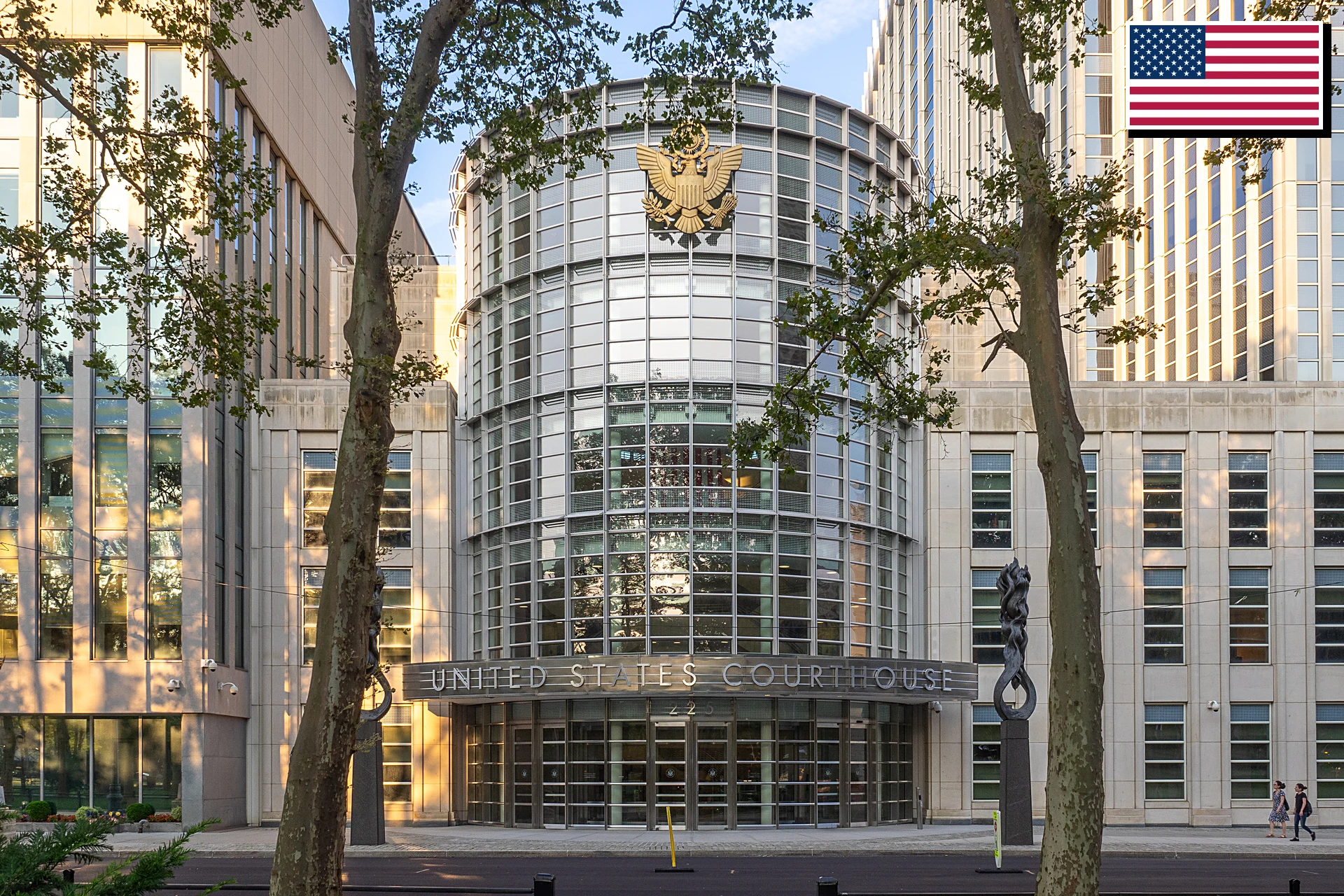
Photo: The United States Courthouse for the Eastern District of New York in Brooklyn, where the jury delivered its verdict. (Ajay Suresh / Wikimedia Commons, CC BY 2.0.)
Read also: Thirteen Dead and Thirteen Still Trapped as Floodwaters Swamp Illegal Gold Mine in Bogor, Indonesia and Fuel Tanker Fire on Cairo's Ring Road Kills at Least 31 in Giza; 21 Injured as Blaze Engulfs 27 Vehicles.
UPDATE — 26 November, 06:26 Bogotá time (11:26 UTC): China hit back on Wednesday, with Foreign Ministry spokesperson Guo Jiakun saying Beijing "firmly opposes the US suppressing and containing Chinese enterprises and firmly supports Chinese enterprises in safeguarding their legitimate rights and interests", the Daily Star reported, citing AFP. Huawei rejected the conviction the same day, calling it "without legal or factual merit" and saying it would "thoroughly review the relevant verdicts and take all necessary legal actions to defend our rights and interests", while welcoming its acquittal on racketeering as confirmation that "these allegations lack factual basis", the Daily Mirror reported. US Attorney General Todd Blanche said after the verdict: "No person or company is above the law. For over two decades, Huawei built its global empire on a foundation of fraud, theft, and deception", Fox Business reported. The verdict came days after Presidents Donald Trump and Xi Jinping met in Shenzhen last week, where Trump described the relationship as "fantastic", Al Jazeera noted.