
UPDATE — November 11, 18:30 Bogotá time (23:30 UTC): Iran’s chief negotiator put the next move squarely on Washington. “The ball is now in the Americans’ court. They must make a decision and announce it,” parliament speaker Mohammad Bagher Ghalibaf told Al Jazeera on Wednesday, saying Tehran has sent the United States a “clear and transparent response” setting out its demands, delivered through Qatari mediation, and has received no official reply, News18 reported. Ghalibaf said mediation cut the proposed response period from seven days to two, and that a six-member committee inside Iran’s Supreme National Security Council, including Foreign Minister Abbas Araghchi, is managing the talks. He also said U.S. representatives visited Moscow and asked President Vladimir Putin to arrange direct talks — a claim neither the Kremlin nor the White House has confirmed. Iran’s security chief Mohsen Rezaei, in an interview with Al-Mayadeen, said no negotiations are under way, called Washington’s first reply “deceptive” and full of ambiguity, ruled out moving “a single particle” of Iran’s enriched nuclear material abroad, and warned that U.S. bases beyond the Middle East, including in Europe, could be targeted if used to attack Iran, The Tribune reported. Araghchi answered Secretary of State Marco Rubio on X, while President Masoud Pezeshkian took Iran’s war damage to the UN climate summit in Antalya.
UPDATE — November 11, 15:30 Bogotá time (20:30 UTC): Iran’s parliament speaker and chief negotiator, Mohammad Bagher Ghalibaf, told Al Jazeera on Wednesday that the Strait of Hormuz “will not return to its prewar arrangements” and will stay closed until Washington meets Tehran’s seven conditions, Shafaq News reported. Ghalibaf said Iran has sent Washington its response outlining the demands and has received no official reply, and urged the United States to announce its decision. He added that Tehran has reached an understanding with Oman on shipping routes and a maritime traffic separation system. On the American side, Secretary of State Marco Rubio told G7 foreign ministers in a closed-door session in Paris that Washington intends to keep its current approach — neither resuming the war nor accepting an unfavorable deal — Axios reported, citing three attendees. Iran’s security chief Mohsen Rezaei, meanwhile, denied U.S. claims that negotiations are under way or that a meeting is planned in Qatar, including reports of talks with Vice President JD Vance.
UPDATE — November 11, 13:30 Bogotá time (18:30 UTC): Washington is now pushing back publicly on Tehran’s account. U.S. Secretary of State Marco Rubio said on Tuesday, at the G7 foreign ministers’ meeting in Paris, that he saw «no need» to attack Iran again, arguing that the economic campaign against Tehran is «so devastating» that further major combat operations are unnecessary, and that Iran is «bleeding economically», The Hindu reported. Tehran, meanwhile, says its offer to reopen the strait within two days — if Washington agrees to a raft of conditions, including ending the war on all fronts, unfreezing Iranian assets, lifting oil sanctions and ending the U.S. blockade of its ports — remains on the table. On Wednesday, U.S. Central Command spokesman Captain Tim Hawkins told Al Jazeera that traffic through the strait «continues to flow» and rejected the idea that Iran controls the waterway: «The strait is open. Those lanes are open. And that is why commercial vessels continue to flow through them», Al Jazeera reported. Hawkins said U.S. forces have helped move more than 900 million barrels of crude oil through the strait since early May, redirected more than 100 ships trying to break the blockade, and cleared mines from the main shipping lanes several weeks ago. Iran’s army, for its part, said on Wednesday that a tanker had struck a mine and caught fire in an «unsafe, prohibited area» in the east of the strait — a claim that, like the Guards’ earlier mine claims, has not been independently confirmed and names no vessel, the Economic Times reported, citing AP.
UPDATE — November 11, 12:35 Bogotá time (17:35 UTC): The picture of this week’s tanker incidents is getting clearer — and it does not match Tehran’s mine claims. The UKMTO reported a second incident on Wednesday involving a tanker in the Strait of Hormuz, giving no details; maritime security firm Vanguard Tech identified the vessel as the Saudi Arabia-flagged NCC Fajr, owned by Saudi Arabia’s National Chemical Carriers Company, Riviera Maritime Media reported. A separate incident on Tuesday involved the Barbados-flagged tanker SEA 1, struck by an unidentified aerial vehicle about 19 nautical miles northeast of Lima, Oman; UKMTO said all crew were safe. Security firm Ambrey reported a further projectile strike on a merchant vessel about seven nautical miles northeast of Lima on Wednesday. None of these independently reported incidents has been confirmed as a mine strike, and Iran’s Revolutionary Guards still have not named any vessel in their mine claims. The International Maritime Organization has confirmed 130 incidents in the region since the conflict began in late February, with at least 25 seafarers killed, The Jerusalem Post reported.
UPDATE — November 11, 11:50 Bogotá time (16:50 UTC): Iran's Revolutionary Guards Navy said on Wednesday that two more oil tankers struck naval mines late on Tuesday night while trying to leave the Strait of Hormuz through what Tehran calls an unauthorized route, and that both vessels caught fire and were abandoned. The statement, carried by Iran's official IRNA news agency, says the tankers had switched off their navigation and identification systems and were sailing under U.S. military cover, and that the fires were still burning despite U.S. firefighting efforts, IRNA reported. The United Kingdom Maritime Trade Operations agency has also reported a tanker incident in the strait, without details, and it is still unclear whether that is one of these two vessels, Shafaq reported. The running tally is confused: Iran had already reported three tankers hit on Tuesday and another in the eastern strait early on Wednesday, and it has not named the two newest vessels or their flags. None of the mine claims has been confirmed independently. Brent crude rose to $92.20 a barrel, up 0.78 percent, Reuters reported, and Washington Institute data cited by Reuters counts 37 ships attacked in October — the highest monthly total since the war began — and 10 attacks so far in November.
UPDATE — November 11, 07:30 Bogotá time (12:30 UTC): A separate vessel struck on Tuesday has now been identified. The Liberia-flagged very large crude carrier MT Fujairah Energy was hit by a projectile on November 10 while sailing from Al Ruwais to Dubai, injuring four crew members, India’s Ports, Shipping and Waterways Minister Sarbananda Sonowal said in a post on X. Six Indian seafarers were aboard; one suffered minor injuries and was taken ashore for medical examination, and the other 18 crew members are safe, Gulf News reported. The maritime publication Safety4Sea, citing the same ministerial statement, added that a second Liberian-flagged crude tanker, the Tarif, was also attacked in the series of incidents between November 7 and 10, and that it remains unclear whether ADNOC’s announcement of damage to one of its vessels refers to a separate incident, according to Safety4Sea. Early on Wednesday, the United Kingdom Maritime Trade Operations agency said it had received a report of another tanker-related incident in the Strait of Hormuz, with the crew’s condition, the extent of damage and the environmental impact still unknown, and advised vessels to transit with caution. It was not immediately clear whether the UKMTO report describes the same incident Iran’s army reported on Wednesday morning or a further one. Gulf News stressed that neither the Fujairah Energy strike nor the UKMTO report should be confused with Iran’s separate claims that tankers struck naval mines. Brent crude was trading at $92.01 a barrel by 0730 GMT, up 0.6 percent, Reuters reported.
UPDATE — November 11, 08:35 Bogotá time (13:35 UTC): Another tanker was reported in a possible attack on Wednesday. The Saudi Arabia-flagged oil tanker NCC FAJR, carrying three Indian seafarers, was involved in a possible attack while transiting the Strait of Hormuz, India’s Ports, Shipping and Waterways Minister Sarbananda Sonowal said. All three Indian nationals — and the entire crew — are safe, the minister said, and authorities are in contact with the ship’s management company, Khaleej Times reported. It was not immediately clear whether the NCC FAJR is the tanker in the UKMTO report from early Wednesday or a further incident. Meanwhile, Iranian President Masoud Pezeshkian accused Washington of pursuing diplomacy through threats, Gulf News reported in its live blog. Commercial traffic through the strait remains severely restricted: only three AIS-visible commercial ships had crossed by 10:40 UTC on Wednesday, and the seven-day average is 6.7 crossings a day, about 8 percent of normal, according to the AIS tracker Hormuz.now.
Iran said on Tuesday that a third oil tanker exploded after striking a naval mine in the Strait of Hormuz, and its Revolutionary Guards claimed "100 percent control" of the waterway, as attacks on shipping showed no sign of slowing despite talk of de-escalation in the war. The mine account comes only from Iranian sources and has not been independently confirmed.
A third oil tanker "attempting to cross an unauthorized route through the Strait of Hormuz exploded after striking a naval mine on Tuesday afternoon," the Islamic Revolutionary Guard Corps (IRGC) Navy said in a statement, according to ABNA. The statement said the tanker was burning in the eastern part of the strait, with smoke from the explosion and the ensuing fire spreading across the area. Earlier on Tuesday, the IRGC Navy had said two oil tankers attempting to navigate a similar route had suffered massive explosions and were left ablaze.
Iran's army said in a separate statement carried overnight that a tanker had struck a mine in the eastern strait while "violating regulations," according to Trend, and warned shipowners that safe passage requires coordination with the Iranian Armed Forces. It was not immediately clear whether the army's statement described the same third tanker or a further incident, and neither Iranian statement named the vessel or reported on its crew.
Guards claim "without any doubt" control of the strait
IRGC spokesman Brigadier General Hossein Mohebbi said the Strait of Hormuz is "without any doubt" under the control of the IRGC Navy, and that "100 percent control of the strait" rests with the Guards, ABNA reported. He also claimed that "even this morning, two vessels that were attempting to pass through the strait illegally, despite being escorted by US F-35 fighter jets, encountered incidents, and their departure was prevented." That claim has not been independently verified, and no Western source had confirmed it by Wednesday morning.
Iran says it destroyed coastal radar and navigational assistance systems belonging to the US military in the southern strait, leaving tankers that try the southern routes near Omani waters at "significantly greater risk than before," according to the IRGC statement. Tehran has declared the southern routes unauthorized and mined, confining what it calls safe passage to designated northern corridors and requiring prior authorization, according to the same statement.
What is independently verified: Sunday's fires, Tuesday's strike off Oman
The latest Iranian claims follow a weekend in which three tankers were hit on Sunday for using "unauthorised routes" through the strait, Iranian state broadcaster IRIB reported, according to Reuters. Videos posted on social media on Sunday and verified by Reuters showed a tanker managed by Navig8 on fire near the coast of Oman, and an image from the European Union's Copernicus Sentinel-2 satellite showed a large cloud of black smoke at the same location. The vessel is managed by Navig8, majority owned by ADNOC Logistics & Services; neither replied to emailed Reuters requests for comment.
On Tuesday, another tanker was struck northeast of Oman's Lima, the United Kingdom Maritime Trade Operations (UKMTO) agency said. UKMTO did not say who struck it. ADNOC confirmed damage to a vessel in United Arab Emirates waters on November 10. At the same time, US forces continued to enforce a naval blockade of Iranian ports: in the latest incident, a US military aircraft fired on and disabled a St Kitts-flagged cargo vessel that tried to depart regional waters after visiting an Iranian port on Saturday, US Central Command said, according to Reuters via The Jerusalem Post.
The scale: 37 ships in October, 10 already in November
There is little sign of attacks abating in November, after 37 ships were attacked in October, the highest monthly total since the start of the war, according to data from the Washington Institute for Near East Policy cited by Reuters. Ten attacks have been recorded so far in November. The International Maritime Organization has confirmed 130 incidents, most of them attacks, in the region since the conflict began in late February, with at least 25 seafarers killed.
Commercial traffic through the strait has collapsed. Only one AIS-visible commercial ship crossed the strait on Wednesday by 06:40 UTC, and the seven-day average is 6.9 crossings a day — about 8 percent of the pre-crisis norm of 84.8 — according to the AIS tracker Hormuz.now. The waterway carries roughly one-fifth of global oil deliveries.
Oil prices rose on Wednesday after falling to two-month lows in the previous session, as the market swung between hopes for de-escalation and concern over the shipping attacks. Brent futures climbed 71 cents, or 0.78 percent, to $92.20 a barrel by 0119 GMT, Reuters reported, and later reached $92.64, up 1.26 percent, by 10:30 Gulf time, according to Gulf News. "Even in the event a deal is struck, an increase in flows through the waterway would still depend on mine clearance, insurance costs and whether or not shipowners would even be willing to take the risk," LSEG analysts said in a November 10 note.
Oil is reaching the shores of Oman
The attacks have caused environmental damage, with oil leaking from damaged tankers. A video shared on social media on Monday, and verified by Reuters, showed oil reaching the shores of Oman, while satellite imagery showed oil spills off the coast of Oman and the UAE. The Omani government did not respond to a Reuters request on Tuesday for comment on the video.
Khor Fakkan municipality temporarily closed Al Luluia beach after oil patches were detected, and reporting linked the contamination to the tanker VIEIRA, which was described as leaking about 65 kilometers off Fujairah, Gulf News reported.
A war with no pause at sea
The conflict began on February 28, and Iran declared the strait closed on March 2, later requiring transit permits and tolls through its Persian Gulf Strait Authority. The United States has enforced a naval blockade of Iranian ports since July 14. Energy infrastructure and civilian facilities have also come under attack elsewhere in the region: Iran and its regional allies have struck targets including the offices of Saudi Aramco, the world's largest oil company, and video verified by Reuters showed damage to Aramco's office building in Riyadh following Houthi-claimed missile strikes on November 8. The Saudi Energy Ministry said a building belonging to Aramco in Riyadh had been targeted in an attempted attack, with debris causing limited damage and no injuries or fatalities.
On Tuesday, crude prices hit two-month lows after US officials downplayed the need for additional military action against Iran, with analysts noting President Donald Trump's more conciliatory tone since the Republicans' defeat in the November 3 midterm elections. But Iran's Supreme National Security Council secretary, Major General Mohsen Rezaei, has warned that the strait will stay closed until the United States meets Iran's conditions, including an end to hostilities, the lifting of the US naval blockade and sanctions, and the reopening of the shipping lanes.
What remains unconfirmed
The mine-strike account of Tuesday’s incidents comes only from Iranian military sources: no independent source has confirmed that the tankers hit mines, identified the third tanker, or reported on the fate of its crew. The Fujairah Energy, struck by a projectile rather than a mine, is the first of Tuesday’s vessels to be identified by name, with four crew injured — but it is a separate incident from the mine claims, and the third tanker’s identity and crew remain unknown. UKMTO did not attribute the strike northeast of Lima. The IRGC spokesman’s claim about two vessels encountering incidents on Wednesday morning despite a US F-35 escort is likewise unverified. What is established is the pattern: verified fires on Sunday, a UKMTO-confirmed strike on Tuesday, a second UKMTO incident report on Wednesday morning, oil on Omani shores, and a strait through which almost no commercial shipping now passes.
Read also: Saudi Arabia Says It Intercepted Three Houthi Missiles Aimed at Riyadh After Pipeline Attack, France Blames Iran's Revolutionary Guard for Cyberattack That Hacked 700 Supermarkets and Russia, Ukraine and U.S. Conclude First Day of Abu Dhabi Peace Talks After Nearly Six Hours.
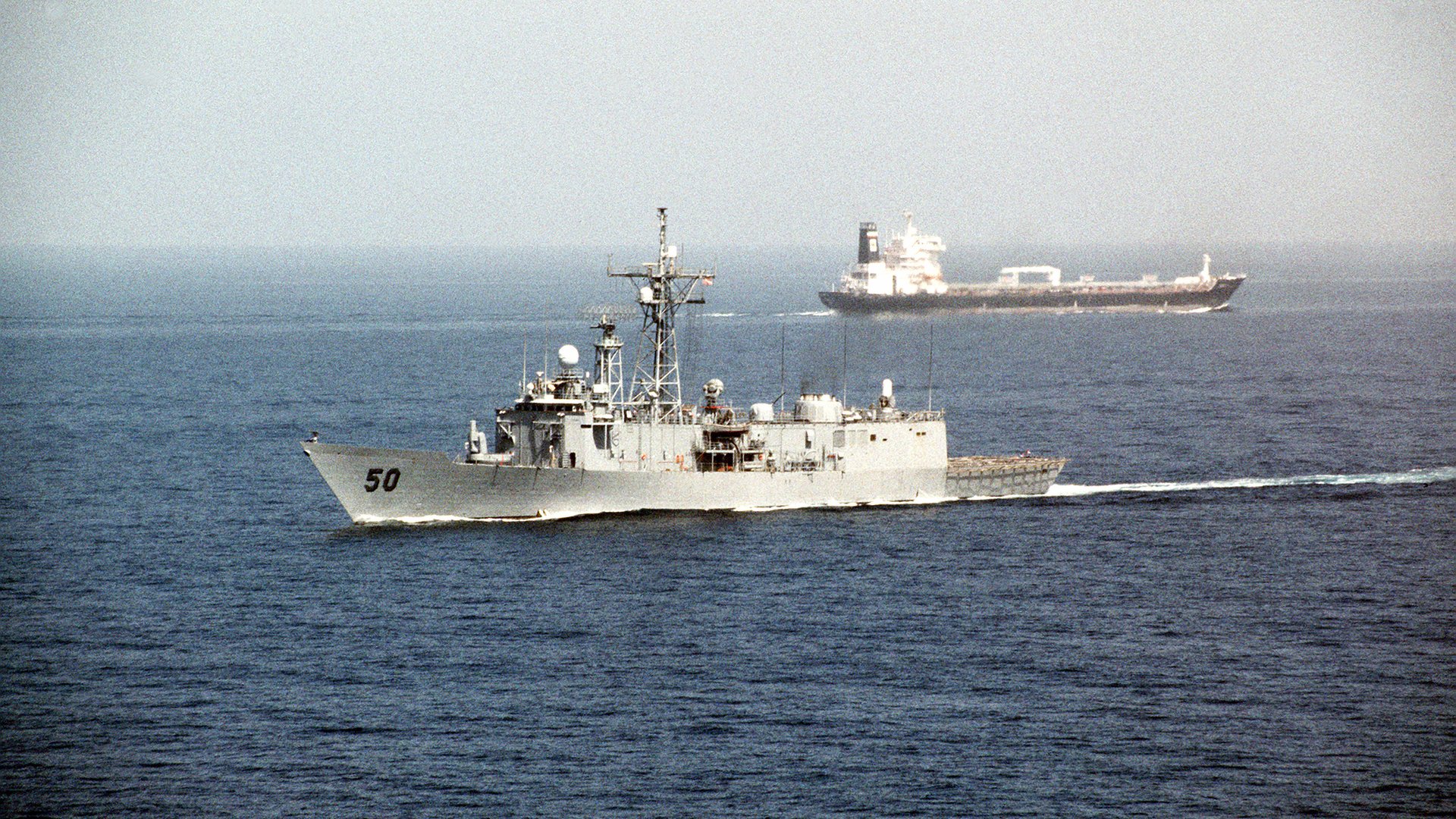
Sources: News18, November 11, 2026; The Tribune (India), November 11, 2026; Reuters, November 11, 2026; The Jerusalem Post (Reuters), November 10-11, 2026; ABNA (IRGC Navy statement), November 11, 2026; Trend (Iranian army statement), November 11, 2026; Gulf News, November 11, 2026; Safety4Sea, November 11, 2026; Hormuz.now AIS tracker, November 11, 2026; Riviera Maritime Media, November 11, 2026; The Jerusalem Post, November 11, 2026; The Hindu, November 11, 2026; Al Jazeera, November 11, 2026; The Economic Times (AP), November 11, 2026. Shafaq News, November 11, 2026; The Times of Israel, November 11, 2026. Cover photo (archive): the guided missile frigate USS Taylor (FFG-50) passes an oil tanker after going through the Strait of Hormuz during Operation Desert Shield, US Department of Defense photo via Wikimedia Commons (public domain). The image is not from today's incidents.