
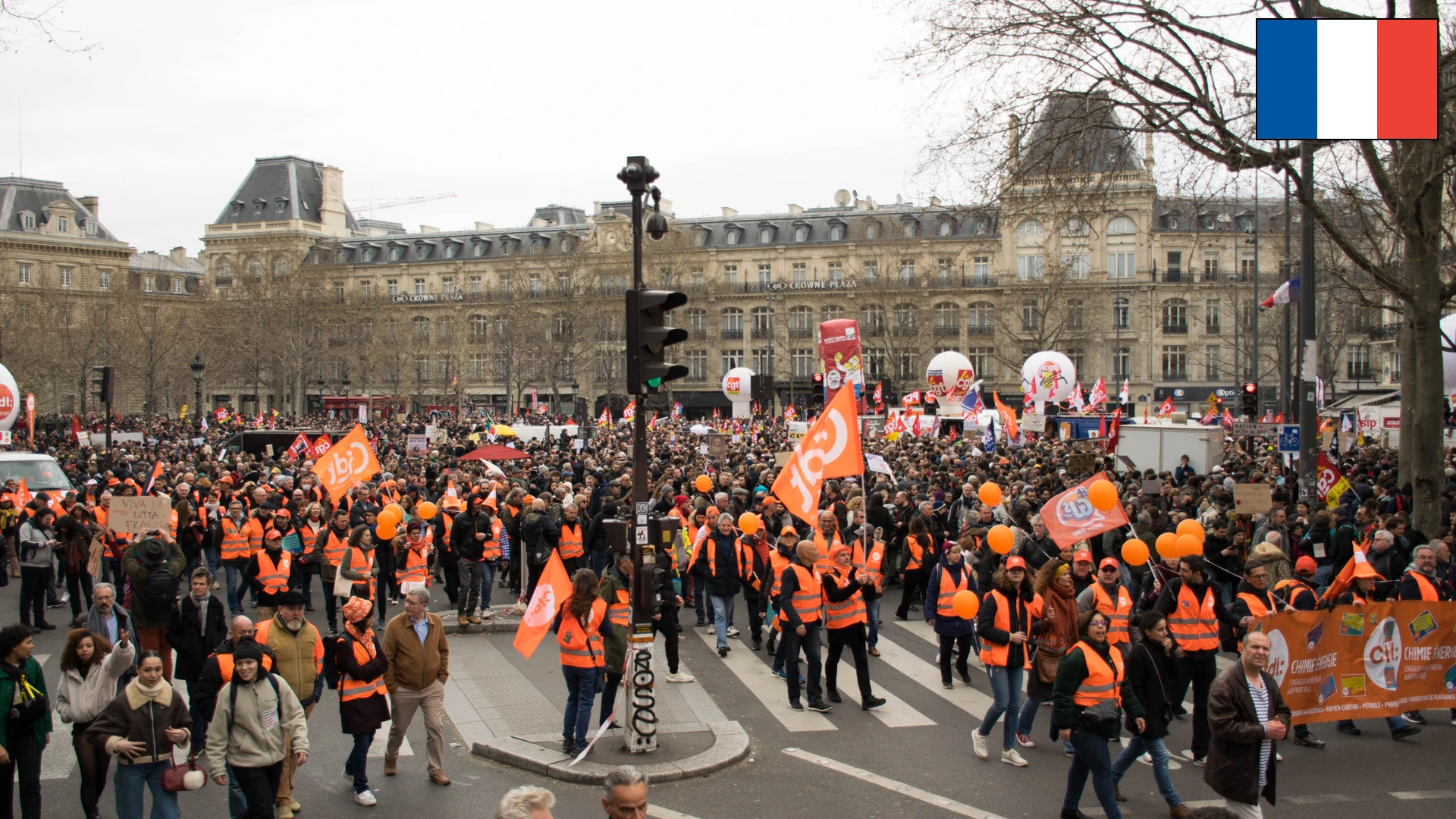
PARIS.- More than 600,000 people marched across France on Thursday, November 5, 2026, in a nationwide general strike over wages, pensions and public services — the biggest day of the autumn protest wave by the government's own count — and Prime Minister Sébastien Lecornu answered within hours by calling unions and employers to a social conference on Monday.
The Interior Ministry counted nearly 600,000 demonstrators across the country by 5 p.m. local time, more than on October 17 (550,000), October 24 (410,000) and October 31 (320,000), Agence France-Presse reported. The Associated Press put the figure at more than 600,000 and noted that the ministry's count was still provisional. The CGT union claimed a far larger turnout of nearly 1.6 million people nationwide, including 350,000 in Paris — a gap between official and union counts that has marked every day of the movement.
A march that began in silence
The Paris march set off peacefully on Thursday afternoon from the Place de la République toward the Place de la Nation, after a minute of silence for the victims of the racist attack in the Yvelines, AFP reported. The attack, in Trappes, left one person dead and five wounded and is being investigated as terrorism — the subject of our earlier report.
Presidential candidates Jean-Luc Mélenchon, Marine Tondelier and Raphaël Glucksmann joined the Paris march. Glucksmann was booed on arrival and left after more than an hour on the march, after the police prefecture reported "black blocs" at the Place de la République.
The strike was the first joint action of France's main unions — the CGT, CFDT, FO, UNSA and FSU, joined by the CFTC, CFE-CGC and Solidaires — bringing together private- and public-sector workers, teachers, rail workers, students, pensioners, farmers from the Confédération paysanne and the Yellow Vests, who have relaunched their protests against the cost of living for three Saturdays running.
The government's answer: a conference on Monday
Faced with hundreds of thousands of workers, civil servants, students and pensioners in the streets, Lecornu announced a "social conference" on Monday with unions and employers, AFP reported. The meeting is intended to "bring answers to questions of purchasing power and wages", Matignon said, and Lecornu will receive the unions and employers at Matignon, Cadena SER reported.
The unions are demanding a substantial rise in the minimum wage. CGT general secretary Sophie Binet, marching at the head of the Paris demonstration, called the day "a success" and demanded a 10% increase in the SMIC, saying the question was no longer whether workers would win but "how much are we going to win?" CFDT leader Marylise Léon asked for a €100 boost to the minimum wage and "concrete answers" for households struggling to make ends meet.
The dispute sits inside the fight over the 2027 budget. Unions are pushing for an additional €10 billion a year for education and a €1,200 increase in the annual minimum wage, which stands at €22,404.20, while ministers are considering a €240-a-year rise in the minimum wage and an extra €1 billion for education, The Times reported.
Mostly peaceful, with clashes in Paris, Lyon and Rennes
Most marches passed off peacefully, but there were clashes in several cities. In Paris, brief tensions broke out and police intervened "to stop wrongdoing and isolate the troublemakers", according to the police prefecture. Hours before the march, demonstrators built a barricade of rubbish bins in the Rue de Rivoli, the main road past the Louvre, The Times reported.
In Lyon, where the prefecture counted 30,500 demonstrators and the CGT 55,000, violence broke out at the head of the march, and an AFP photographer wearing a press armband was struck five times with a baton during a CRS charge, AFP reported. In Rennes, clashes multiplied from 3 p.m. after a march of between 20,600 people (prefecture) and 35,000 (unions) that had started in a good mood. Near Toulouse, masked protesters set fire to offices inside the Lycée Françoise in Tournefeuille with fireworks, forcing pupils and staff to evacuate, Reuters reported.
Interior Minister Laurent Nuñez had deployed 70,000 police officers and gendarmes nationwide and promised an "extremely firm" response to any disorder, after admitting that policing during the October 17 protests — which ended in rioting and looting — had been a "failure".
Schools, trains and landmarks shut down
The strike bit into schools and transport. About 16% of teachers were on strike, according to the Education Ministry, while the Snes-FSU union counted 52% of staff on strike in secondary schools. Nearly 1,000 lycées were blocked or administratively closed, the Snes-FSU said, against 81 counted by Matignon. A third of higher-education institutions were "disrupted", the government said, while the student union claimed 90% of France's roughly 70 universities were mobilised.
More than one in three rail workers were on strike at the SNCF, and 18.9% of EDF staff were out at midday as annual pay talks opened in the electricity and gas industries. Tourists hoping to visit the Eiffel Tower or the Arc de Triomphe were turned away: both monuments stayed closed for the day.
A movement that began in a school
The wave began in September with a protest over staff shortages at a high school south-east of Paris and spread nationwide, the Associated Press reported. What started as students demanding better schools and funding broadened into a fight over wages, the cost of living, housing and public services, and has now produced the largest turnout of the autumn by the Interior Ministry's count — five months before France's next presidential election, in which Emmanuel Macron cannot seek another consecutive term.
Our earlier coverage traced the movement from the October 24 marches, when 410,000 people took to the streets, through the spread of the youth revolt across Europe — see Europe Protests Escalate: 410,000 March in France, 128 Arrested in Barcelona, and a Nationwide Strike Set for November 5 and Europe's Youth Revolt Spreads From France to Germany as Students Blockade Dozens of Schools and Frankfurt Protesters Injure More Than 100 Police.
What remains open
The Interior Ministry's count is still provisional, and the final tally — including the Paris figure — has yet to be published. The test now moves to Matignon: whether Monday's social conference produces concrete measures on wages and the minimum wage, or only a timetable for further talks. The Yellow Vests have called for strikes and blockades to continue on Friday, November 6, followed by further demonstrations on Saturday, RFI reported.
Read more on The Wire Post: Europe Protests Escalate: 410,000 March in France, 128 Arrested in Barcelona, and a Nationwide Strike Set for November 5, Europe's Youth Revolt Spreads From France to Germany as Students Blockade Dozens of Schools and Frankfurt Protesters Injure More Than 100 Police and Macron Calls Trappes Shooting a 'Racist Terrorist Attack' After One Killed and Five Wounded.
Sources: Agence France-Presse via Boursorama, November 5, 2026; Associated Press, November 5, 2026; Reuters, November 5, 2026; Cadena SER, November 5, 2026; France 24, November 5, 2026; The Times, November 5, 2026; RFI, November 5, 2026. Cover photo: a demonstration in Paris on March 28, 2023 (CC BY-SA 4.0, Jules* via Wikimedia Commons), with a small flag of France added in the top-right corner. The photo shows an earlier Paris march, not today's demonstration.