
Israeli tanks crossed the "Yellow Line" in central Gaza on Wednesday, November 18, launching the first ground operation beyond the ceasefire boundary since the U.S.-brokered truce took effect on October 10, 2025. An Agence France-Presse journalist saw Israeli tanks position themselves east of the Nuseirat refugee camp, and witnesses told the BBC that armour rolled onto Salah al-Din road, Gaza's main north-south highway, under the cover of artillery strikes. The Israeli military said the joint operation with the Shin Bet security service aimed to dismantle a tunnel it described as an immediate threat to its troops, while Hamas called the incursion "a flagrant violation of the ceasefire agreement."
"The army and the internal security agency Shin Bet launched the joint operation to dismantle a terror tunnel west of the Yellow Line that posed an immediate and direct threat to IDF troops," the military said in a statement, according to AFP. "IDF troops under the Southern Command are deployed in the area in accordance with the ceasefire agreement and will continue to operate to remove any immediate threat and thwart attempts by the Hamas terrorist organisation to harm Israeli civilians or IDF troops, or to violate the agreement," the military added, according to the BBC. An Israeli army spokesperson told AFP on Wednesday evening that the operation was ongoing.
Evacuation orders, closed roads and families fleeing again
The operation centred on the area around the Nuseirat and Bureij refugee camps in central Gaza. Early on Wednesday afternoon, the Israeli military body COGAT announced the start of the incursion and warned Palestinians living in an area north of the two camps to stay away for their own safety. According to The Times of Israel, COGAT told residents of blocks 660, 661 and 666 to leave; blocks 661 and 666 lie entirely on the Hamas side of the Yellow Line, while 660 sits in a restricted zone beyond the original ceasefire demarcation. COGAT also told international aid organisations working in Gaza to avoid any movement in the affected areas, and said the army was taking "necessary measures to minimize the risk of harm to the civilian population."
A stretch of Salah al-Din road was closed to traffic where it passes through the area. In one video verified by BBC Verify, a man can be seen ducking after hearing artillery fire and then running along Salah al-Din road, about 1.5 kilometres (0.9 miles) west of the Yellow Line. A Gaza security source told AFP there was "intense Israeli artillery shelling" north of Nuseirat refugee camp, with Israeli military vehicles in central Gaza "amid ongoing gunfire and airstrikes since midday."
Residents fled the area, many of them not for the first time. "When we heard the sounds of shelling and explosions, we were terrified, especially since the area we live in is close to the points of incursion," Um Ahmad al-Tartoori, a resident of the Al-Bureij camp, told AFP. "We fear this may be the start of a broader operation and that displacement will begin anew, as we have not yet recovered from the effects of the previous war and displacement," Mahmoud al-Saafin, a 27-year-old resident of Bureij, told AFP. Most of Gaza's 2.1 million people have been displaced at least once since the war erupted following Hamas's October 7, 2023 attack on Israel.
Gaza's civil defence agency said three Palestinians were killed and others wounded in three separate Israeli drone strikes on Wednesday — one man near the Nuseirat camp, one in Gaza City and one outside the Deir el-Balah police station. It was not immediately clear whether the three strikes were linked to the ground operation. The Israeli military told AFP that in the first two strikes it targeted "terrorists" and that it was not aware of the third attack. Al Jazeera also reported, citing an official at al-Awda Hospital, that an Israeli attack on al-Mughraqa, near the operation area, killed one person and wounded several others.
The Yellow Line, and why this crossing matters
The Yellow Line was declared by Israel after the current ceasefire began in October 2025. It separates the areas under Israeli military control from the areas controlled by Hamas, with Israel saying it controls more than 60 percent of the Palestinian territory. Al Jazeera reported that the line originally left Israeli forces holding about 53 percent of Gaza, but that Israel has gradually moved it and it now encompasses around two-thirds of the enclave, with more than two million Palestinians living in the rest, mostly in tents.
Until Wednesday, Israel's tunnel-clearing campaign had been conducted on its own side of the line. The operation near Nuseirat and Bureij is the first time since the ceasefire that Israeli ground forces have publicly crossed it. The military has not said how long the operation will last.
The incursion came after inconclusive Israeli elections, with opposition figure Gadi Eisenkot trying to form a government without caretaker prime minister Benjamin Netanyahu, who has built his brand on saying he will ensure Israel's security. Israel's defence minister, Israel Katz, said Israel would not withdraw until Hamas is dismantled. "If tensions escalate on the various fronts, we are fully prepared to seize additional territory, evacuate local residents and incorporate it into Israel's permanent security perimeter," Katz said, according to Al Jazeera.
Hamas calls it a "flagrant violation"; mediators urged to act
Hamas called the operation "a flagrant violation of the ceasefire agreement and confirmation that the occupation has reneged on its obligations," and urged mediators to "intervene immediately." It accused Israel of "systematically" squeezing Palestinians into a narrow area of Gaza, and Netanyahu's caretaker government of escalating to escape its domestic crises. The Popular Front for the Liberation of Palestine called the operation a "prelude" to a wider escalation aimed at forcibly displacing Palestinians.
The operation also landed the day the United States-backed Board of Peace warned that the 13-month-old agreement risks collapse. In a report to the United Nations Security Council, the board accused Israel of restricting aid and delaying the deployment of Palestinian police, and Hamas of continuing armed activity and taxing goods entering Gaza. "Should it collapse, there would be no road map to return to, no administration to deploy and no enabling environment to rebuild," the board wrote. Senior Hamas official Basem Naim dismissed the report as "pure disinformation."
A ceasefire that stopped major fighting — but little else
The ceasefire halted major fighting, but the rest of the plan — Israel's withdrawal, reconstruction and Hamas's disarmament — has stalled. Hamas agreed in July to a roadmap to give up its weapons and hand over governance; Israel rejected it. Israel also has not let the board's technocratic administration start work in Gaza, which has held up an international stabilisation force, the Associated Press reported.
Israeli forces have kept up near-daily attacks, shelling and home demolitions since the ceasefire began. More than 1,600 Palestinians have been killed since the start of the ceasefire, according to an AFP tally based on data from the Gaza health ministry, whose figures are considered reliable by the United Nations. Over the same period, the Israeli military says seven of its soldiers have been killed, as well as one civilian contractor. On Tuesday alone, Israeli fire killed six Palestinians, including a six-year-old boy, Gaza's civil defence agency and hospitals told AFP. On Saturday, an Israeli attack killed Samir Abu Younis, the Qassam Brigades' Rafah commander.
Aid remains restricted. About 100,000 tents are waiting to enter Gaza, held up by crossing closures and lengthy Israeli security checks, the International Organization for Migration says.
What is still not known
The Israeli military has not said whether the tunnel has been destroyed, how long its troops will stay west of the Yellow Line, or whether the operation will expand. It is not confirmed whether the three deadly drone strikes on Wednesday were part of the ground operation. Hamas has not said whether it will respond militarily, and the mediators — the United States, Egypt and Qatar — have not publicly commented on the incursion. The operation also leaves open whether the Board of Peace's warning about the ceasefire collapsing will now become the central question of the trilateral summit in Shenzhen on Thursday, where Presidents Donald Trump, Xi Jinping and Vladimir Putin are due to meet.
Read also: Israel Kills Hamas Rafah Brigade Commander Samir Abu Younis in Gaza Strike, the Third to Die in 18 Months, Israeli Strike Hits Nasser Hospital in Gaza, Killing Seven Including Surgeon Rezik Abushira and a 13-Year-Old Boy and Israel's President Tasks Gadi Eisenkot With Forming Government in Major Setback for Netanyahu.
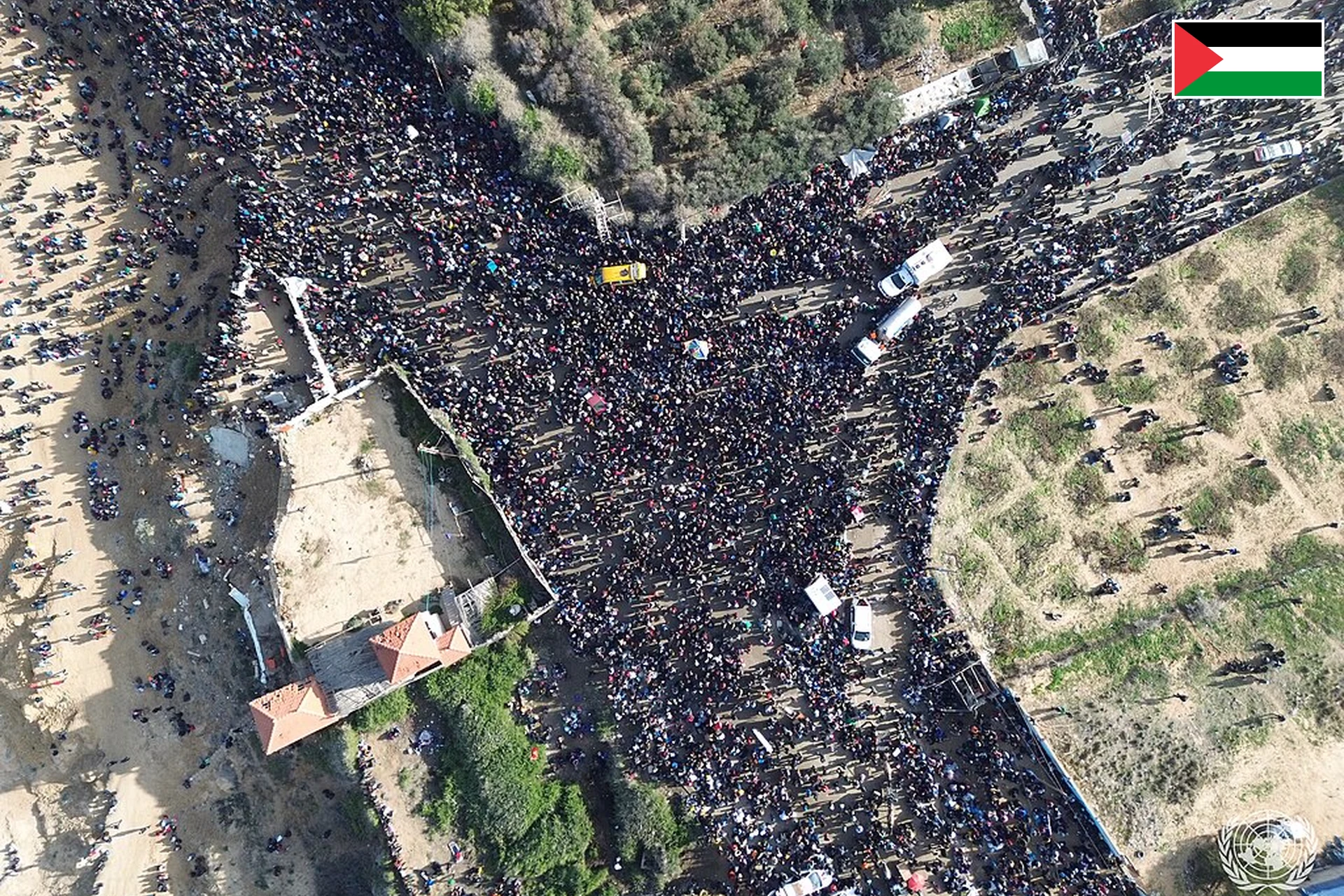
Sources: AFP via NDTV, November 19, 2026; Al Jazeera, November 18, 2026; BBC News, November 18, 2026; The Times of Israel, November 18, 2026. Cover photo: Displaced Palestinians in northern Nuseirat, Gaza, in January 2025. Photo by Ashraf Amra / UNRWA, via Wikimedia Commons (CC BY-SA 3.0 IGO). Archive photo.