
SEOUL.- North Korea test-fired a newly designed air-defence missile system and staged a long-range cruise missile strike drill on Wednesday, November 4, 2026, its state media reported on Thursday, in what South Korea's Yonhap news agency counted as Pyongyang's fourth weapons test in a week. South Korea's military independently confirmed that multiple missiles were fired toward the sea from the country's east coast that morning, Yonhap reported.
The launches add to a rapid run of North Korean weapons activity — a rocket-artillery firing, a cluster-bomb test and a cruise-missile warhead trial in the space of seven days — and came as the United States and South Korea carry out joint air drills and as Americans voted in midterm elections.
What North Korea says it tested
According to the official Korean Central News Agency (KCNA), the North's Missile Administration test-fired the new air-defence missile system to confirm its technical capabilities. "The test-fire proved the technical specifications and reliability of the new material and intelligent multiple guided mode of the projectile, target identification and tracking capability of the air-defense missile system and its detection information processing device," KCNA said, Yonhap reported.
In the same announcement, KCNA said a firepower subunit of the long-range strategic cruise missile unit in the eastern area staged a strike drill with a long-range strategic cruise missile against a virtual airport target — and that the missile "perfectly" hit it. Images released by Pyongyang show fighter-jet-shaped targets on a runway exploding, NHK reported.
The test was overseen by Kim Jong-sik, a member of the Central Military Commission, Yonhap reported. North Korean leader Kim Jong Un did not attend, The Chosun Daily reported.
What Seoul confirmed — and what it has not
South Korea's Joint Chiefs of Staff (JCS) said it detected the North firing multiple missiles toward the East Sea from the Sondok area in South Hamgyong Province early on Wednesday. The missiles are believed to have flown less than 300 kilometers, with the South Korean authorities leaving open the possibility that they involved a close-range ballistic missile, Yonhap reported.
That independent confirmation establishes that launches took place. What it does not establish is whether the new air-defence system performed as KCNA claims — that rests, for now, on Pyongyang's word and its photographs.
Analysts who studied the released images offered two readings. Shin Jong-woo, secretary general of the Korea Defense and Security Forum, said the new air-defence missile, first unveiled in November 2025, appears to have a guidance section resembling Russia's S-400 surface-to-air missile system. Shin also said images appeared to show the cruise missile carrying a cluster warhead, Reuters reported.
A week of tests
Wednesday's launches were the fourth North Korean weapons test in a week, according to Yonhap's count. The sequence began last Thursday, October 29, with the firing of a 600-millimeter "ultra-precision" multiple rocket launcher, with leader Kim Jong Un in attendance. On Saturday, October 31, the North tested a cluster bomb that can be mounted on tactical ballistic missiles. On Monday, November 2, it tested a "dispersal warhead" for a strategic cruise missile.
Notably, the Rodong Sinmun, the official newspaper of the ruling Workers' Party of Korea, did not cover the last three events, Yonhap reported.
Why now, according to analysts
Experts cited by Yonhap said the latest tests appeared to be aimed at responding to Freedom Flag, the ongoing South Korea-U.S. air drills. Earlier in the week, Kim Jong-sik criticized the allies' combined exercises, including Freedom Flag, accusing the "enemies" of intensifying their "military moves in public or behind closed doors."
The timing also coincided with the U.S. midterm elections, widely seen as a referendum on U.S. President Donald Trump halfway into his second term. South Korean experts said North Korea may have wanted to underscore its presence during the elections, as Trump has expressed a willingness to meet Kim Jong Un, NHK reported.
Wednesday's launch also came as Kim Yo-jong, the powerful sister of the North Korean leader, issued back-to-back statements this week rejecting a U.S. investigation that blamed the North for stealing more than $6 billion in cryptocurrency from Binance, the world's largest cryptocurrency exchange, Yonhap reported.
What remains unconfirmed
The performance of the new air-defence system is, so far, only Pyongyang's claim; Seoul is still analyzing the missiles' specifications and has not settled on their types. The reading that the cruise missile carried a cluster warhead rests on imagery analysis by a single expert. And neither Washington nor Seoul has yet announced a formal response to this week's launches. This article will be updated if South Korea's military releases a fuller assessment or if the United States responds.
Read more on The Wire Post: Kim Jong Un's North Korea Tests a Cluster-Bomb Warhead for Tactical Missiles and Vows to Field Four Types This Year, Binance Hit by $6.3 Billion Crypto Heist, the Largest on Record, as Investigators Point to North Korea's TraderTraitor and Donald Trump Says US Is Probing North Korea Link as FBI Blames Pyongyang for the $6.3 Billion Binance Hack.
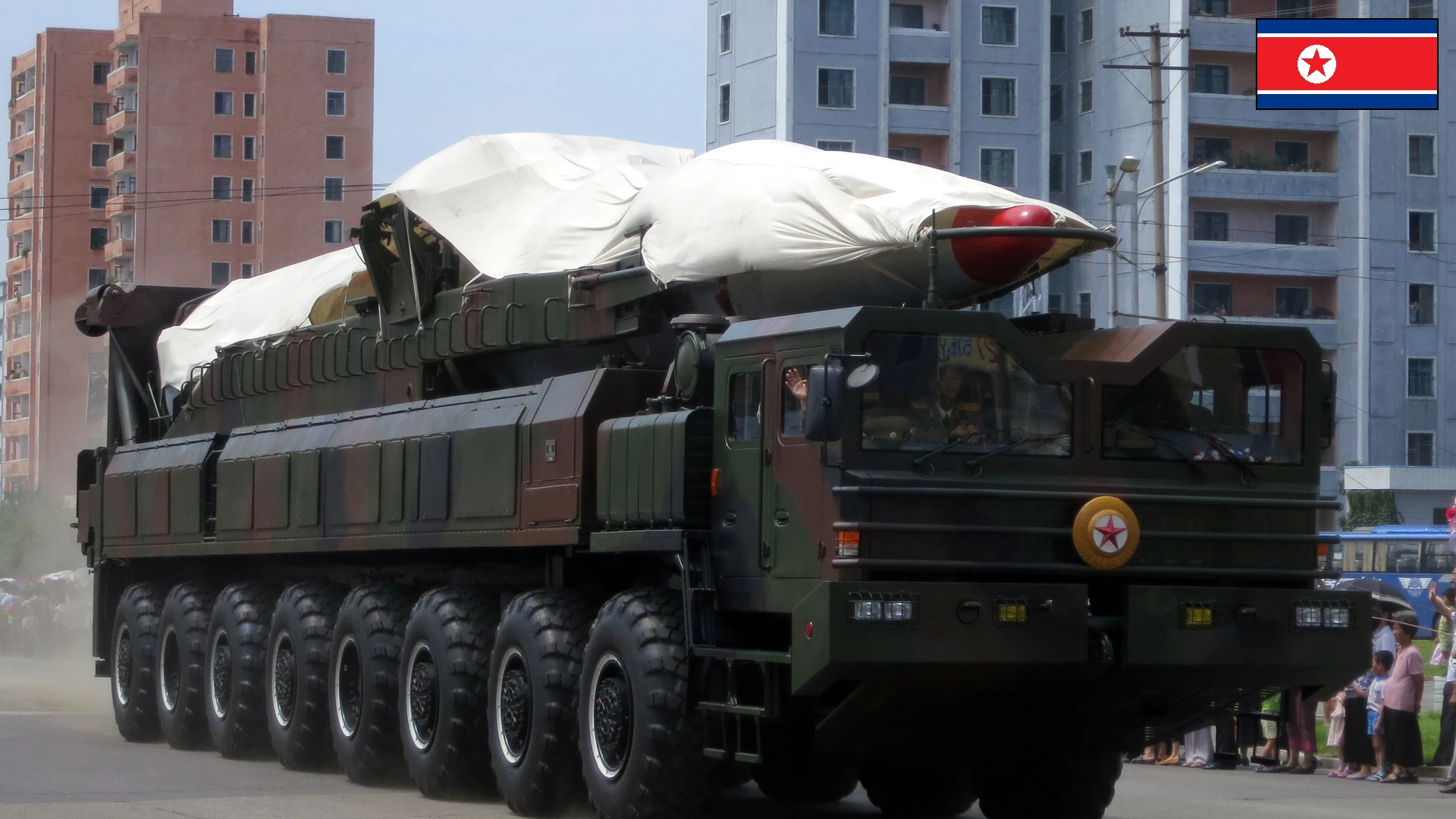
Sources: Yonhap News Agency, November 5, 2026; Reuters, November 5, 2026; NHK World-Japan, November 5, 2026; The Chosun Daily (English), November 5, 2026. Cover photo: A North Korean ballistic missile on display during a military parade in Pyongyang in July 2013 (CC BY 2.0, Stefan Krasowski via Wikimedia Commons), with a small flag of North Korea added in the top-right corner.