
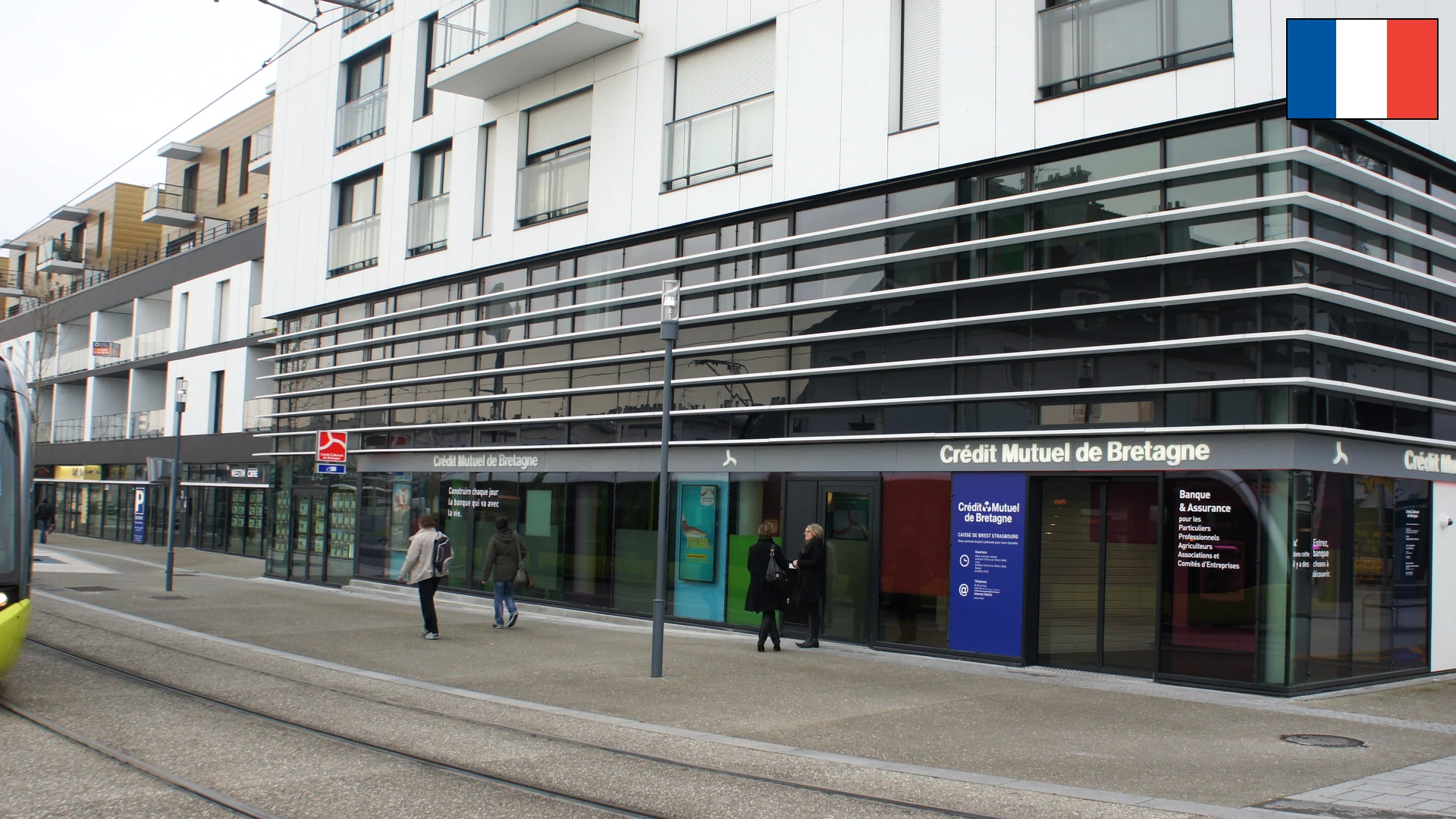
PARIS.- French bank Crédit Mutuel Arkéa said on Thursday, November 5, 2026, that about €100 million ($112.61 million) is missing after a cyberattack this week, and that it cannot yet say how much of the money it will be able to recover. The theft, carried out through the bank's own accounts and then converted into cryptocurrency, is a rare successful heist against a large financial institution, Reuters reported.
The Brittany-based mutual bank, which has more than 5.8 million customers and €211.5 billion in assets, confirmed on Wednesday that it had been the victim of a cyberattack. The hackers did not touch customer accounts, the bank said: they used an account belonging to Arkéa itself to carry out fraudulent transfers to other banks, and the stolen funds were then converted into cryptocurrencies on specialised platforms, Reuters reported and the bank confirmed to Agence France-Presse.
How the money vanished
The break-in was spotted before the bank went public. Suspicious movements were first flagged on Monday, November 2, by ZachXBT, an independent researcher who tracks funds on the blockchain, and by the American crypto exchange Kraken, which sounded the alarm after receiving unusually large transfers for a European bank and blocked the transactions in progress, Le Monde reported.
According to Le Monde's reconstruction, the hackers compromised the computer of a third party who had authorization to carry out transactions, giving them deep access to the bank's systems. From there they reached Arkéa's equity capital — the bank's own funds, not its customers' money — and siphoned off more than €100 million out of the roughly €10 billion it holds. The stolen funds were then converted into cryptocurrencies and distributed across several exchange platforms. A portion of the money has been blocked and recovery efforts are under way, the bank said.
Arkéa said the attack has now been contained, ruled out human error, and described it as "a sophisticated attack coming from the outside". The bank also rejected media reports that its online banking subsidiary Fortuneo was the entry point, saying there had been no entry through Fortuneo and that neither the division nor its customers' accounts were involved. While the bank temporarily suspended some transactions as a precaution, causing delays to some transfers, customer assets were not affected, Reuters reported.
The bank declined to confirm a figure of $133 million in losses reported by the newspaper Le Télégramme, but confirmed the scale of the losses. "The amount of funds concerned by the attack, which is still being evaluated, was not ... such to undermine the financial health and solidity of the group," the bank said, according to AFP.
A first for a European bank
Cybersecurity experts interviewed by Le Monde called the episode a first. "I am stunned," said a veteran of banking cybersecurity. "This episode will send a wave of anxiety through every institution in the sector and will leave a mark. Bankers, more than any other industry leaders, hate risk." Gabriel de Brosses, founder and head of the consulting firm Tevarua Conseil and former head of cybersecurity at Groupe La Poste, said: "This is an attack of unprecedented scale and damage. Normally, this does not happen to banks."
The size of the theft raises questions about the controls that should have stopped it. "There is normally a whole array of mechanisms designed to prevent large, uncontrolled financial movements. Alarms should have sounded," de Brosses said. Banking losses are not unusual — they happen when a corporate customer can no longer repay its debts, as with supermarket chain Casino or telecoms group Altice — but this is the first time a European bank, and especially a French one, has suffered an uncontrolled loss of such magnitude, Le Monde reported.
The money is large even for a bank of Arkéa's size. The group posts about €430 million in annual profits, so the theft represents roughly the equivalent of one quarter's net profit; for its parent company, Crédit Mutuel, the incident represents 2.2% of annual results, Le Monde reported. The lender earned a net profit of €230 million in the first half of 2026, according to AFP. "This is a major wake-up call for the entire French and European financial sector. It proves that traditional banks are fully at risk," a banker from the French sector told Le Monde.
Who did it? Too early to say
The break-in closely resembled the attack on the cryptocurrency platform Binance on October 29, in which $6.3 billion in cryptocurrency was stolen. That theft has been attributed by experts and US authorities to North Korea, which in recent years has become highly skilled at stealing digital assets. But it is too early to identify those responsible for the Arkéa hack, Le Monde reported.
ZachXBT, who first spotted the suspicious movements on Monday and alerted his community on Telegram, said the operation targeting the French bank did not originate from North Korea. All possibilities remain open: experts cited by Le Monde raised the growing power of actors from drug-trafficking circles with "staggering resources" — "laundering money is their second business" — and the possible complicity of a disgruntled employee. One thing is certain, de Brosses said: the amount stolen and the stealth of the operation showed a highly sophisticated attack carried out with "very detailed knowledge of banking procedures".
The attack comes a week after the Binance theft and a wave of cyberattacks targeting internet-connected fridges in Europe, Reuters reported. While successful hacks of large financial institutions are rare, financial regulators globally have stepped up warnings about the risk of cyberattacks, particularly with the growth of artificial intelligence.
What happens next
Arkéa said it has informed the European Central Bank, French banking supervisors and prosecutors. The Paris prosecutor's office said its cybercrime unit received a complaint from the bank on Wednesday and immediately opened an investigation into an organised attack on an automated data processing system, Reuters reported.
What remains to be confirmed is how much of the €100 million can be recovered — a portion has already been blocked, but the final figure is still being evaluated — who carried out the attack, and why the controls that should have flagged transfers of this size did not stop them. The bank has not identified the third-party service provider whose platform was used in the attack. This article will be updated if the bank, prosecutors or regulators give a recovery figure or name a suspect.
Read more on The Wire Post: Binance Hit by $6.3 Billion Crypto Heist, the Largest on Record, as Investigators Point to North Korea's TraderTraitor, Donald Trump Says US Is Probing North Korea Link as FBI Blames Pyongyang for the $6.3 Billion Binance Hack and France's Economy Shrinks as Inflation Rises in October.
Sources: Reuters, November 5, 2026; Le Monde, November 5, 2026; Agence France-Presse via Gulf News, November 4, 2026. Cover photo: A Crédit Mutuel de Bretagne branch in Brest, France (CC BY-SA 4.0, via Wikimedia Commons), with a small flag of France added in the top-right corner.