
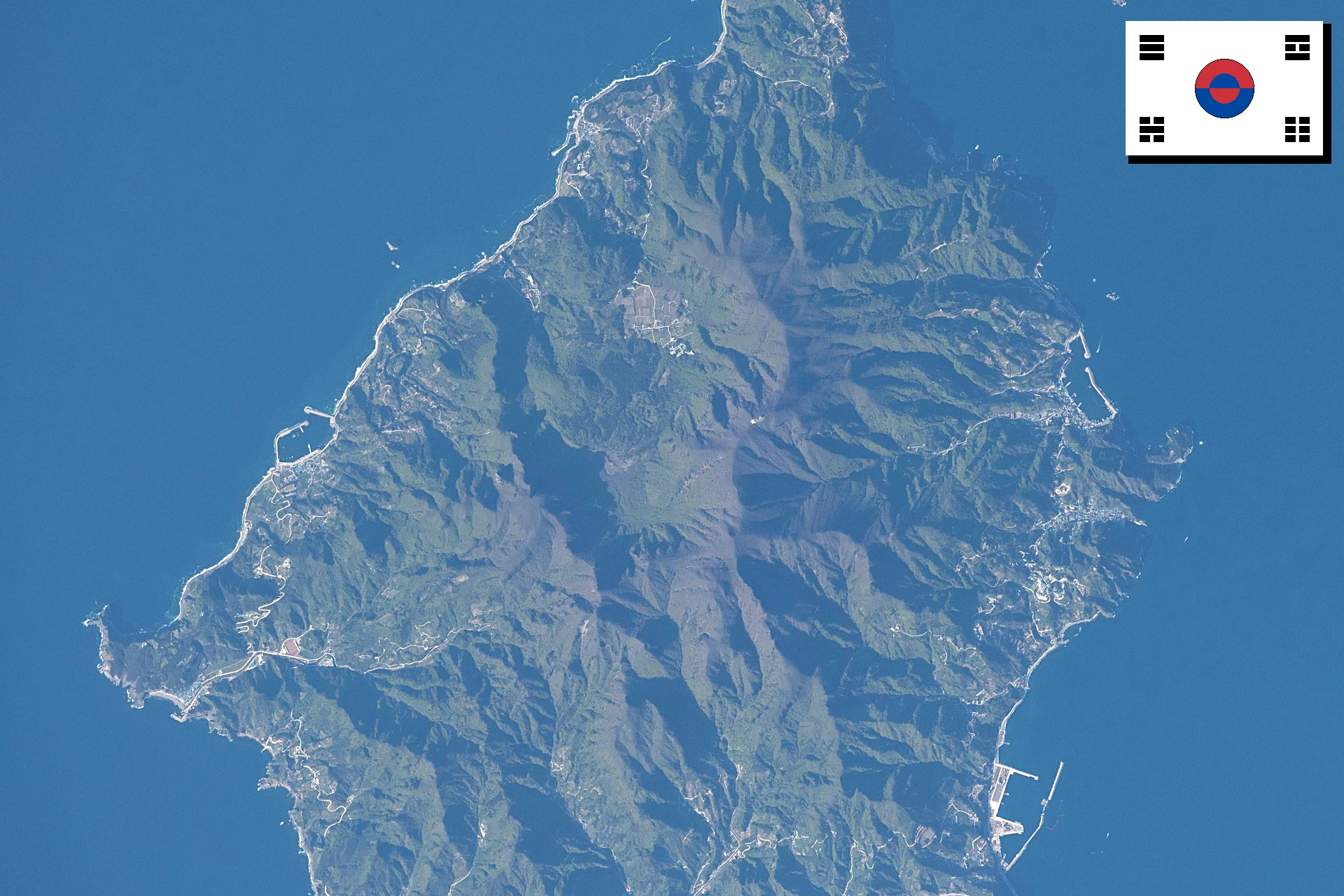
Fewer than five Russian military aircraft entered South Korea's air defense identification zone over the East Sea early on Tuesday, November 24, approaching Ulleung Island before turning away, South Korea's Joint Chiefs of Staff said. The South Korean Air Force scrambled fighter jets, including F-15Ks, in response, and the Russian planes left the zone without violating South Korean airspace. But for about five minutes, residents of the island were told to take shelter from what officials wrongly described as a suspected North Korean aircraft.
The confusion began at 7:52 a.m. local time (5:52 p.m. Monday in Bogotá), when the Ministry of the Interior and Safety sent an emergency text to residents of Ulleung County, in North Gyeongsang Province, saying a Russian aircraft had violated South Korean airspace and urging them to move to underground facilities or inside buildings. The alert was lifted within minutes — the safety ministry said three minutes later, while the provincial government put the all-clear at 7:57 a.m. — but the follow-up message from the province then told residents the aircraft was "suspected to be North Korean," Yonhap reported.
The Joint Chiefs of Staff then clarified what had actually happened: "The aircraft were Russian military planes, not North Korean drones," the military said, according to Yonhap. "Several Russian military aircraft entered South Korea's air defense identification zone over the East Sea on Tuesday morning." The planes approached Ulleung Island and flew away toward the East Sea as South Korean fighters responded, and "there was no airspace violation."
A training phrase that slipped into a real alert
South Korea's Defense Ministry said the erroneous reference to a North Korean aircraft came from a training-related phrase that North Gyeongsang Province mistakenly inserted into the message lifting the alert, NewsPim reported. The ministry, the safety ministry and the local government gave differing accounts of the same incident in the space of minutes, and the mix-up drew an immediate political backlash.
Chung Hee-yong, secretary-general of the opposition People Power Party, demanded that the government "transparently disclose the details of the incident, the reason why the announcement was reversed, and the entire response process," the Maeil Business Newspaper reported. "The announcement was initially known as an invasion of territorial airspace by a Russian aircraft, but the announcement changed in just about 10 minutes due to the invasion of an aircraft believed to be a North Korean aircraft," Chung said.
The Defense Ministry said it would summon the Russian defense attaché in Seoul later on Tuesday to lodge a strong protest, NewsPim reported. The military said it had detected the Russian planes before they entered the zone and deployed fighter jets as a precaution. An F-15K was photographed taking off from a military air base in Daegu at around 9 a.m. on Tuesday, the Korea Herald reported.
What an air defense zone is — and is not
An air defense identification zone is not sovereign airspace. It is a buffer area a country declares beyond its territory so its military can identify approaching aircraft early and reduce the risk of an accidental clash. Entering it without notice is not the same as violating airspace, and it is standard international practice for military aircraft to file a flight plan before entering another country's zone. Russia does not recognize South Korea's zone or its legal basis, SBS reported.
That distinction is why the military's clarification mattered: the Russian planes entered the zone, flew close to Ulleung Island's airspace, and left. The Joint Chiefs of Staff did not disclose the exact types of aircraft involved, their flight path, how close they came to the island, or the purpose of the flight, Asia Today reported.
The third entry in eight days
Tuesday's incident was the third time in eight days that Russian military aircraft entered the zone, the Korea Herald reported, following similar entries on November 17 and November 19. The pattern is not new: Russian aircraft entered the zone on August 25 near Ulleung Island and Dokdo, and about 10 Chinese and Russian aircraft entered it during a joint aerial patrol on June 27. Defense Ministry data cited by the Korea Herald show Russian aircraft entered the zone fewer than 10 times in 2020, around 10 times in 2021, around 20 times in 2022 and around 10 times in 2023.
The one clear precedent for an actual violation came in July 2019, when a Russian A-50 early warning aircraft crossed into South Korean airspace over Dokdo twice, prompting South Korean fighter jets to fire about 360 warning shots. Tuesday's encounter ended without an airspace violation, and no one was reported hurt.
Ulleung Island, known as Ulleungdo, is a volcanic island about 120 kilometers (75 miles) east of the Korean Peninsula in the East Sea, part of North Gyeongsang Province and South Korea's least populated county. Its residents were told to return to their daily lives minutes after the alert, but the mistaken warning — and the contradictory messages that preceded it — left the government facing questions about how a routine military interception turned into a false alarm about North Korea.
What is still unknown
The Joint Chiefs of Staff has not said what types of Russian aircraft were involved, their exact route, how close they came to Ulleung Island, or why they flew there. The Defense Ministry has not said when the Russian defense attaché will be summoned or what exactly it will demand. It is also not yet clear how a training phrase ended up in a live civil defense alert, or what the government will change to keep it from happening again.
Lee también: Russian Missiles Crash in Poland as Tusk Calls It an Intentional Provocation and NATO Chief Warns of Response, Denmark Foils Alleged Russian Plot to Kill Rapper Kyivstoner, Expels Moscow's Defense Attaché y Russian Warship Merkury Capsized and Sunk in Suspected Ukrainian Drone Attack at Libya's Benghazi Port.
Fuentes: Yonhap, 24 de noviembre de 2026; Reuters, 24 de noviembre de 2026; Korea Herald, 24 de noviembre de 2026; SBS, 24 de noviembre de 2026; NewsPim, 24 de noviembre de 2026; Korea JoongAng Daily, 24 de noviembre de 2026. Portada: isla de Ulleung vista desde la Estación Espacial Internacional — foto de dominio público de la NASA (ISS064), vía Wikimedia Commons; bandera de Corea del Sur (dominio público).
UPDATE — 24 November, 06:26 Bogotá time (11:26 UTC): South Korea’s Defense Ministry has now summoned the Russian military attaché in Seoul, Col. Nikolai Marchenko, and lodged a formal protest. Kim Hak-jo, the ministry’s director general for international policy, told Marchenko that the repeated and unauthorized entries by Russian military aircraft into South Korea’s air defense identification zone, including Tuesday’s flight near its territorial airspace, were unacceptable acts that could stoke unnecessary tensions, Yonhap reported. The Foreign Ministry also expressed regret to Moscow through diplomatic channels. The military said it was the first time it had issued a preliminary air raid alert over a possible airspace intrusion by Russian warplanes. The Russian jets’ entry into the zone lasted about 20 minutes: after South Korea’s F-15Ks deployed in response, the jets veered off toward Japan and exited the zone before flying northward.
UPDATE — 24 November, 07:26 Bogotá time (12:26 UTC): South Korea’s foreign ministry said it conveyed its regret to Russia over the incident through diplomatic channels and called for measures to prevent a recurrence, but it stopped short of summoning the Russian ambassador, Yonhap reported. The message was sent to the Russian Embassy in Seoul, while the defence ministry’s formal protest went to military attaché Nikolai Marchenko. The Russian jets came within about 20 km of Ulleung Island’s northern territorial airspace, and the military believes they would likely have entered territorial airspace if the Air Force had not responded immediately, Maeil Business News reported. It was the fifth time this year that Russian military aircraft have entered the KADIZ, the Korea Herald reported.
UPDATE — 24 November, 09:33 Bogotá time (14:33 UTC): Moscow has now responded. Russia's Embassy in Seoul said the Russian military aircraft did not violate international law when they flew near Ulleung Island on Tuesday, and that, as in previous similar cases, Russia was acting in accordance with international law norms, Maeil Business Newspaper reported, citing TASS. The embassy said South Korea's air defense identification zone was set unilaterally by the Korean government and imposes no legal obligations on aircraft from other countries; Russia does not recognize the zone's binding power. When military attaché Nikolai Marchenko arrived at the Defence Ministry, reporters asked whether Moscow had intended to violate South Korean airspace; he said only "no comment" and left, the Korea Times reported. The confusion over Tuesday's alerts also deepened: North Gyeongsang Province acknowledged it had used a drill template written for North Korean aircraft scenarios, changing only the timestamp, and its 8:39 a.m. correction — replacing "North Korean aircraft" with "Russian aircraft airspace violation" — was still inaccurate, because the Joint Chiefs of Staff had already confirmed no airspace violation took place. The English version of the 7:52 a.m. alert read "EVACUATION, AIR RAID", a higher level than the precautionary alert actually issued, and sirens sounded across Ulleung Island. Opposition People Power Party secretary general Jung Hee-yong demanded the government transparently disclose the full circumstances and explain why its statements were repeatedly contradicted.