
BENGHAZI, Libya. — A Russian Navy corvette capsized and sank at a naval base in Benghazi on Sunday after a suspected sea drone attack, satellite images show, in the latest spillover of Russia's war on Ukraine into the Mediterranean — and hours later a second drone struck a commercial ship off the same coast.
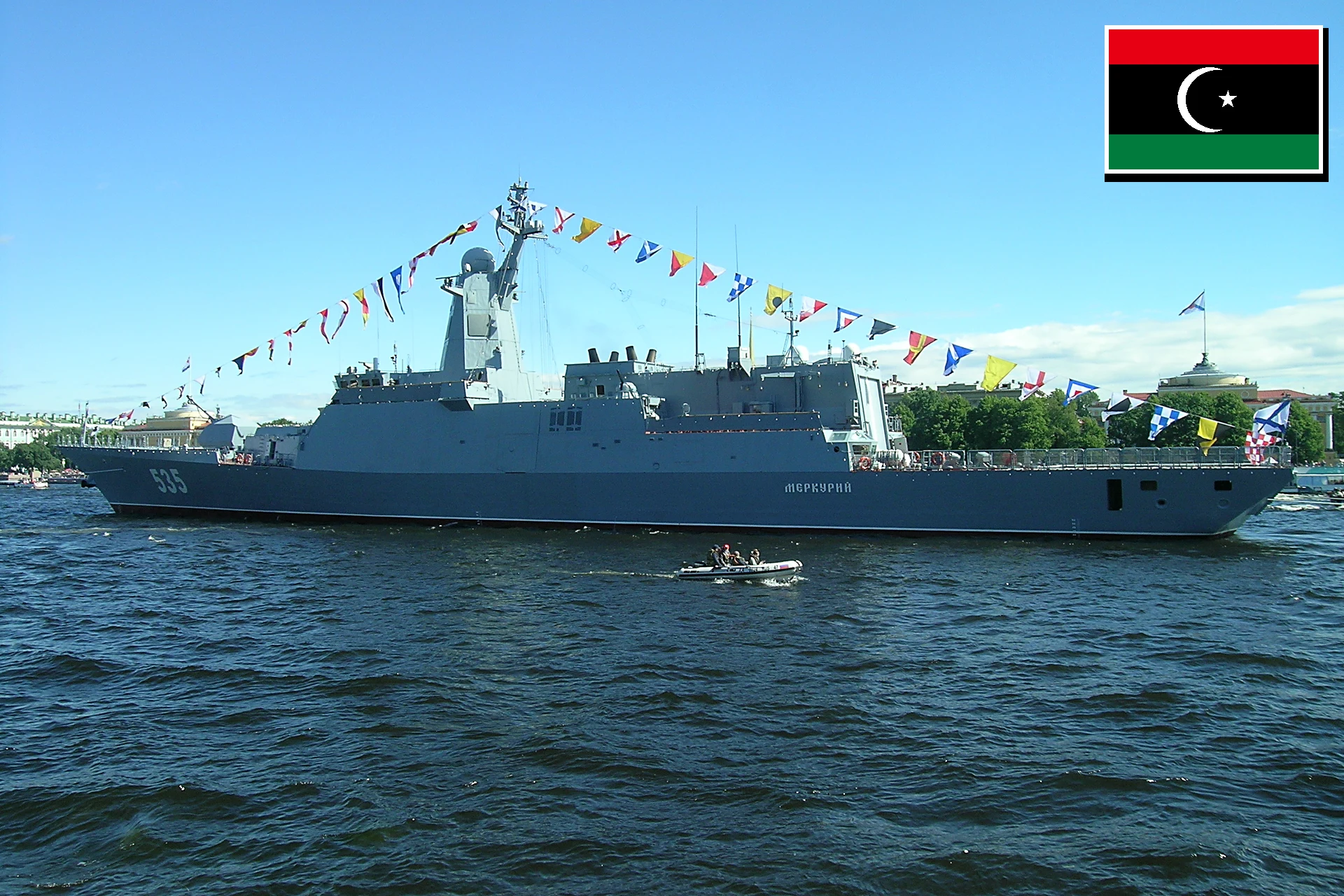
Cover photo: The Russian Navy corvette Merkury (hull number 535) at the naval parade in St. Petersburg in July 2022. Photo: 13243546A, via Wikimedia Commons, CC BY-SA 4.0. Flag of Libya added.
The explosion aboard the Merkury erupted at dawn on Sunday, November 22, setting off a brief fire at the Benghazi Naval Base in eastern Libya, Al Jazeera reported. Satellite imagery from provider Vantor showed most of the warship had capsized and sunk, with only its bow still visible above the water, smoke rising from part of the superstructure and significant debris scattered along the pier.
Libya's eastern-based government said a preliminary investigation pointed to a suspected drone attack. The government said the vessel had stopped at the port to refuel and take on supplies under a maritime cooperation agreement with Russia's eastern administration, while on its way back to Russia, and that the fire had been brought under control and the site secured.
Two versions of the casualties
How many people were hurt — and whether anyone was killed — is disputed, and neither account has been independently confirmed.
Medical sources told news agencies that 10 Russians and Libyans sustained minor injuries and were receiving treatment in Benghazi, Arab News reported.
But local sources told Al Jazeera late on Sunday that an unknown number of Libyan and Russian nationals were killed in the attack. Those sources said the ship was moored inside the civil sea port of Benghazi, close to the naval base, and that it was carrying weapons, ammunition and drones in its cargo. Residents quoted by the sources said they saw three drones attack the vessel.
The eastern-based government has not confirmed any deaths, and has not commented on the cargo claim.
Who is blamed — and who has not claimed it
Two Libyan military officials affiliated with the self-styled Libyan National Army, which controls eastern and southern Libya, told the Associated Press that several Ukrainian sea drones were launched at the ship from a base run by Ukrainian forces in western Libya, according to the AP report. The officials, who spoke on condition of anonymity because they were not allowed to talk to reporters, said at least four drones were intercepted and destroyed, while two hit the warship.
Axios reported that Ukraine's SBU security service conducted the long-range strike, citing a source with knowledge of the operation.
No one has claimed responsibility for the attack, and there was no immediate reaction from Russia, Al Jazeera reported.
Tallha Abdulrazaq, a Middle East security and defence expert, told Al Jazeera that Ukrainian intelligence services were most likely behind the strike. He pointed to reporting from late last year about a deal between Ukrainian intelligence services and the Tripoli government to establish a Ukrainian military and intelligence presence in western Libya, with Tripoli receiving Ukrainian military expertise in exchange. He called the Benghazi strike a "spillover" of Russia's war on Ukraine and "the latest example of what [Ukrainian] President [Volodymyr] Zelenskyy has long described as 'Ukrainian long-range sanctions against Russia'".
A second ship hit hours later
On Sunday evening, a sea drone hit a Malta-flagged commercial vessel off the port of Benghazi in a separate attack, two Libyan military sources told Reuters. Libya's Health Ministry said all crew members injured in that strike had been rescued and were receiving treatment, and were in stable condition.
Libyan naval and air forces intercepted more than 20 drone boats off the Benghazi coast that evening, the military sources told Reuters. The Almasar satellite television channel said naval and air forces destroyed at least 12 other sea drones off the Mediterranean city.
Libya asks the UN to investigate; the UN agrees
The eastern-based government said it has launched a joint investigation with Russia to "uncover the circumstances of the attack, its source, and the party behind it". It condemned the suspected strike as a violation of Libya's sovereignty and a threat to maritime safety.
"The Libyan government will not allow Libyan ports, territory or territorial waters to be turned into an arena for settling scores or exporting international conflicts," the government said, adding that Libya was "not a party to the Russian-Ukrainian war".
Prime Minister Osama Hamad said his government had submitted a formal request to the UN General Assembly and Security Council for an international investigation, calling for scrutiny of "suspicions that the boats had been launched from western Libya… and for verification of the presence of Ukrainian experts in the country, as well as formal explanations from Kyiv about their activities".
On Monday, the United Nations Support Mission in Libya (UNSMIL) called for an immediate, independent and transparent investigation into the attacks at Benghazi Seaport and off the city's coast, warning against actions that could drag the country into wider regional conflicts. "Libya cannot afford, and must not become a battleground for foreign conflicts," the mission wrote on X early on Monday.
A widening pattern at sea
The Benghazi strike came a day after a drone struck a Russian cargo ship, the Sparta II, in the eastern Baltic Sea near Finnish waters on Saturday. Finland's border guard attributed that strike to Ukraine, Al Jazeera reported.
It is not the first Russian vessel attacked off Libya. A Russian liquefied natural gas carrier sank off the Libyan coast in March after an attack that Russian President Vladimir Putin blamed on Ukraine. Last December, Ukraine said it had used aerial drones to strike a Russian-linked oil tanker in the Mediterranean.
Since Russia launched its full-scale invasion of Ukraine in February 2022, Ukrainian forces have repeatedly used naval drones and missiles to target Russian warships and naval facilities in the Black Sea. The Benghazi attack, if confirmed as a Ukrainian operation, would mark one of the furthest extensions of that campaign from the Black Sea — into the central Mediterranean, at a port where Russia has been building a military foothold.
Libya has been divided since a NATO-backed uprising toppled longtime leader Muammar Gaddafi in 2011. A United Nations-recognised government is based in Tripoli, and a rival administration in the east is based in Benghazi.
What is still to be confirmed
The casualty toll remains unresolved: the official account speaks of 10 people with minor injuries, while local sources report an unknown number of Libyans and Russians killed. The cargo claim — that the Merkury was carrying weapons, ammunition and drones — has not been confirmed by any official source. Ukraine has not claimed the attack, Russia has not publicly reacted, and the joint Libyan-Russian investigation and the requested UN inquiry have only just begun. The condition of the Malta-flagged commercial vessel and the full extent of the damage at the Benghazi base have also not been detailed.
Related coverage: Russian missiles crashed in Poland days earlier in a spillover that Warsaw called an intentional provocation, covered in Russian Missiles Crash in Poland as Tusk Calls It an Intentional Provocation and NATO Chief Heads to Warsaw, and Houthi missiles fired at Riyadh marked another regional escalation, covered in Houthis Fire Three Missiles at Riyadh After Saudi Coalition Strikes Hodeida Port.
Sources: Al Jazeera; Arab News; Associated Press; Al Arabiya; South China Morning Post; Fox News.
UPDATE — 23 November, 04:28 Bogotá time (09:28 UTC): Ukraine has now claimed responsibility. President Volodymyr Zelenskyy said on Monday that seven Ukrainian-made naval drones sank the Merkury, destroying an embarked Ka-27 combat helicopter, and that a second target, the Russian dry cargo vessel MV Angara, was also hit. Zelenskyy said Kyiv accused Moscow of using the Angara to transport weapons, thanked the Security Service of Ukraine and the Defence Forces, and vowed to continue operations in “designated waters”. Russia’s ambassador to Libya, Aydar Aganin, condemned the attacks as terrorism and said Moscow would not leave them unanswered, accusing Kyiv of trying to expand the conflict to maritime areas far from the combat zone, Reuters reported, and ANI reported.
UPDATE — 23 November, 05:27 Bogotá time (10:27 UTC): Zelenskyy has released dramatic footage of the attack, showing the Ukrainian sea drones speeding towards the Merkury before the ship erupted into a giant ball of flames in the Benghazi dock. Ukraine’s intelligence agency said the drone boats were “transported to the designated location and launched from a so-called ‘mothership’”. The Merkury is a 1,800-ton, 344-foot corvette, one of the newest ships in Russia’s fleet, commissioned in 2023. Russia has not yet commented on the attacks. The Merkury joins some 40 other Russian naval vessels lost in the war, most notably the guided-missile cruiser Moskva, the Black Sea Fleet flagship sunk by a Ukrainian missile attack in April 2022, CNN reported, and Reuters reported.
UPDATE — 23 November, 06:25 Bogotá time (11:25 UTC): Russia has now responded to Zelenskyy’s claim. Moscow said it had “taken note” of the Ukrainian president’s statement, Kremlin spokesperson Dmitry Peskov told reporters on Monday, adding: “Our defense ministry is handling this. Likewise, any information – should it be deemed necessary to release any – will be provided through the defense ministry.” The Kremlin offered no denial or confirmation of the attack itself. The response came hours after a suspected Ukrainian drone hit a Russian cargo ship about 2,000 miles away in the Baltic Sea, CNN reported.
UPDATE — 23 November, 07:27 Bogotá time (12:27 UTC): Moscow hardened its tone on Monday. Kremlin spokesperson Dmitry Peskov called the Baltic Sea attack on the Russian cargo ship “very dangerous” and said it represents “an escalation of tension in the region”, CNN reported. Meanwhile, Russia managed to tow the damaged Sparta II out of Finnish waters on Sunday night, after the cross-border firefighting operation, the Wall Street Journal reported. Libya’s Tripoli-based government said it was following the Benghazi reports with “grave concern” about the danger of exposing the country’s civilian ports to “external conflict”. Ukraine’s Security Service described the Benghazi operation as “unique”: the sanctioned cargo vessel MV Angara was used to transport Russian military equipment, and the Merkury regularly escorted Russian naval convoys, including guarding the Angara, the South China Morning Post reported.
UPDATE — 23 November, 12:28 Bogotá time (17:28 UTC): A second vessel was hit off Benghazi on Sunday evening. A Maltese-flagged commercial ship was struck by a drone boat, two Libyan military sources told Reuters, and its crew was rescued, some with minor injuries. Libyan naval and air forces intercepted more than 20 explosive-laden drone boats off the coast that evening, the sources said, Gulf News reported. The commercial vessel has not been officially identified, and it is not clear who launched the second attack, Al Jazeera reported.
UPDATE — 23 November, 13:27 Bogotá time (18:27 UTC): Early reports of an explosion at an ammunition depot inside the Benghazi naval base were later corrected by eastern Libyan authorities, who said the blast happened aboard the Russian ship docked in the port and was suspected to have been caused by drones, CNA reported. The ship was on its way back to Russia and had stopped in Benghazi for refuelling and resupply, and the eastern administration said it would open a joint investigation with Russia. The fire was brought under control with no casualties reported, Libya's National Safety Authority said, according to Xinhua.
UPDATE — 23 November, 20:28 Bogotá time (01:28 UTC): Ukrainian special forces stationed in Libya had studied the movement of Russian warships and commercial vessels for months before the attack, according to people familiar with the operation, The Wall Street Journal reported. Before dawn on Sunday, a Ukrainian team launched seven explosive-laden sea drones from a mother ship in the Mediterranean off the North African coast, a Ukrainian military official said. The drones came under fire from helicopters and automatic weapons mounted on motorboats before slamming into the corvette and the nearby cargo ship; most targeted the Merkury, and at least one drone boat struck the Angara. Ukrainian operatives based in Western Libya had also carried out sabotage attacks on at least three vessels linked to Russia sailing in the Mediterranean last year, the people familiar with the operation said; Ukraine has not publicly acknowledged those attacks. Libya's Foreign Ministry demanded immediate, official clarifications from Ukraine on whether any Libyan territory, ports or facilities were used to plan, execute or provide logistical support for the operation. “We hit back when Russia attacks us,” Zelensky said in his address on Monday to NATO's parliamentary assembly. “And today, Russia can feel our response all the way from Western Siberia, where its oil refineries are burning, to the coast of Libya, where its warships are sinking.” Satellite images showed two Russian cargo ships, the Anastassia and the Yuriy Arshenevskiy, arriving at Tobruk in September with military vehicles aboard, and Russia had been scaling up its military deliveries to Libya, according to Jalel Harchaoui, a Libya-focused analyst at the Royal United Services Institute. “What attracted the Ukrainians was not the delivery,” Harchaoui said. “It was the presence, the symbolic presence of the Russian navy itself.”
UPDATE — 24 November, 07:26 Bogotá time (12:26 UTC): Libya has escalated its response. Musa al-Koni, deputy chairman of the UN-backed Presidential Council, called the Benghazi attack a “declaration of war” against Libya and held Ukraine “fully responsible” for what he described as terrorist acts, saying President Volodymyr Zelensky had claimed and boasted about them, Libya’s state news agency LANA reported. Al-Koni said Tripoli would “immediately begin taking all necessary legal and diplomatic measures”, including referring the matter to the International Court of Justice, the UN Security Council and other international bodies. He called on the Security Council to convene an emergency session and asked for Zelensky to be placed on a terrorism watchlist, and urged Libya’s joint military committees to hold emergency meetings. Daily Sabah reported the same escalation, noting that both of Libya’s rival governments have condemned the attacks, while the eastern-based government has separately filed a complaint with the UN seeking an international investigation.
UPDATE — 24 November, 08:29 Bogotá time (13:29 UTC): Ukraine's foreign minister, Andrii Sybiha, said on Tuesday that the weekend drone attack on Russian ships in Libyan waters was a legitimate act of self-defence under Article 51 of the United Nations Charter, arguing that both Russian naval vessels and cargo ships transporting military equipment are valid targets, Reuters reported. Sybiha said Ukraine was “not ‘dragging’ anyone into the war” and that Russia was endangering third countries by using their civilian infrastructure for military purposes. Foreign Ministry spokesperson Heorhii Tykhyi told reporters the same day that the strikes were a lawful use of self-defence under Article 51 and that international law does not limit self-defence to Ukraine's own territory, the Kyiv Independent reported. In an interview published on Tuesday, President Volodymyr Zelenskyy confirmed that Ukraine was also responsible for Saturday's drone strike on the Russian cargo vessel Sparta II in international waters in the Gulf of Finland, saying it was a legitimate target because it was carrying weapons; the damaged vessel was towed back to the Russian port of St Petersburg, Russia's Transport Ministry said on Tuesday. Russia's defence minister has not commented publicly on the Libya attack.
UPDATE — 24 November, 20:29 Bogotá time (01:29 UTC): The Libyan National Army General Command said on Tuesday that two of its military personnel had died from injuries sustained in the attack on Benghazi port, adding that its response to the strike would come “at the appropriate time and place”, Reuters reported. They are the first Libyan military deaths officially confirmed from the attack.
UPDATE — 24 November, 22:33 Bogotá time (03:33 UTC): The casualty toll from the strike is now disputed. Al Jazeera reported on 24 November, citing local authorities, that the attack resulted in the deaths of at least 10 Libyan and Russian crew members. That figure conflicts with the account given to Reuters by medical sources, already reported in this article, that ten people, including Russians and Libyans, were slightly injured and were being treated in Benghazi. No names of the dead have been published, and the only deaths confirmed so far by the eastern Libyan authorities remain those of the two Libyan soldiers reported earlier. The conflicting tolls have not been independently verified.
UPDATE — 24 November, 23:33 Bogotá time (04:33 UTC): New detail on where the ship was hit: sources told Al Jazeera that the Merkury was moored in the civilian area of Benghazi seaport, close to a naval base, when the drones struck — not inside the naval base itself. The death toll remains disputed: local authorities told Al Jazeera the strike killed at least 10 Libyan and Russian crew members, while medical sources told Reuters 10 people were lightly injured and in treatment in Benghazi, and no names of the dead have been published.
UPDATE — 25 November, 05:27 Bogotá time (10:27 UTC): The two Libyan soldiers who died of their wounds have now been named: R.A.O. Al-Tahir Abdullah Al-Sadiq and Second Lieutenant Ali Muhammad Al-Said, LaPresse reported, citing a Facebook post by Saddam Haftar, deputy commander of the Libyan National Army, mourning \u201ctwo heroes of our naval forces.\u201d Transliterations of the names vary between sources (Al-Taher/Al-Tahir; Al-Sayed/Al-Said). They remain the only deaths officially confirmed by the eastern Libyan authorities; the wider death toll is still disputed, as noted above.
UPDATE — 25 November, 07:29 Bogotá time (12:29 UTC): The two Libyan naval officers wounded in Sunday's attack, Al-Taher Abdullah al-Sadiq and Lieutenant Ali Mohammed al-Said, died on Tuesday evening from their wounds, the Libyan National Army's General Command said in a statement late Tuesday, Al Jazeera reported. The LNA vowed to retaliate "at the appropriate time and place, and by the appropriate means," according to Arab News. The wider casualty toll from the attack remains disputed: Al Jazeera has cited local sources for a higher death toll, while Reuters reported 10 people lightly wounded.
UPDATE — 26 November, 11:28 Bogotá time (16:28 UTC): Italy has denounced the strike, with Foreign Minister Antonio Tajani saying it was a mistake for Ukraine to "violate Libya's sovereignty" and that Rome had received no prior notice of the operation, Al Jazeera reported. "Italy was absolutely unaware of Kyiv's intentions to strike in Libyan territorial waters, even inside a port," Tajani told Italy's Corriere della Sera newspaper. Tajani telephoned his Ukrainian counterpart, Andrii Sybiha, on 24 November to voice his concern and reaffirm Italy's commitment to Libya's territorial integrity, the Italian Foreign Ministry said, Interfax-Ukraine reported, adding that Italy "will remain at Ukraine's side" but that the war must not be allowed to spread. The League, a member of Prime Minister Giorgia Meloni's coalition, also criticised the attack, calling it "unacceptable", and opposition parties have pressed the government over what Rome knew, Italian Insider reported.