
STARBASE, Texas.- SpaceX caught its Starship spacecraft in the mechanical arms of its launch tower on Saturday, November 14, after the vehicle spent more than 22 hours in orbit, completing the first round trip of a vertically launched spacecraft to orbit and back to the very spot where it left Earth. The 52-metre ship circled the planet 14 times and deployed 26 Starlink satellites before returning to Starbase, Texas, in what the company and Reuters called a key milestone on the road to a fully reusable rocket.
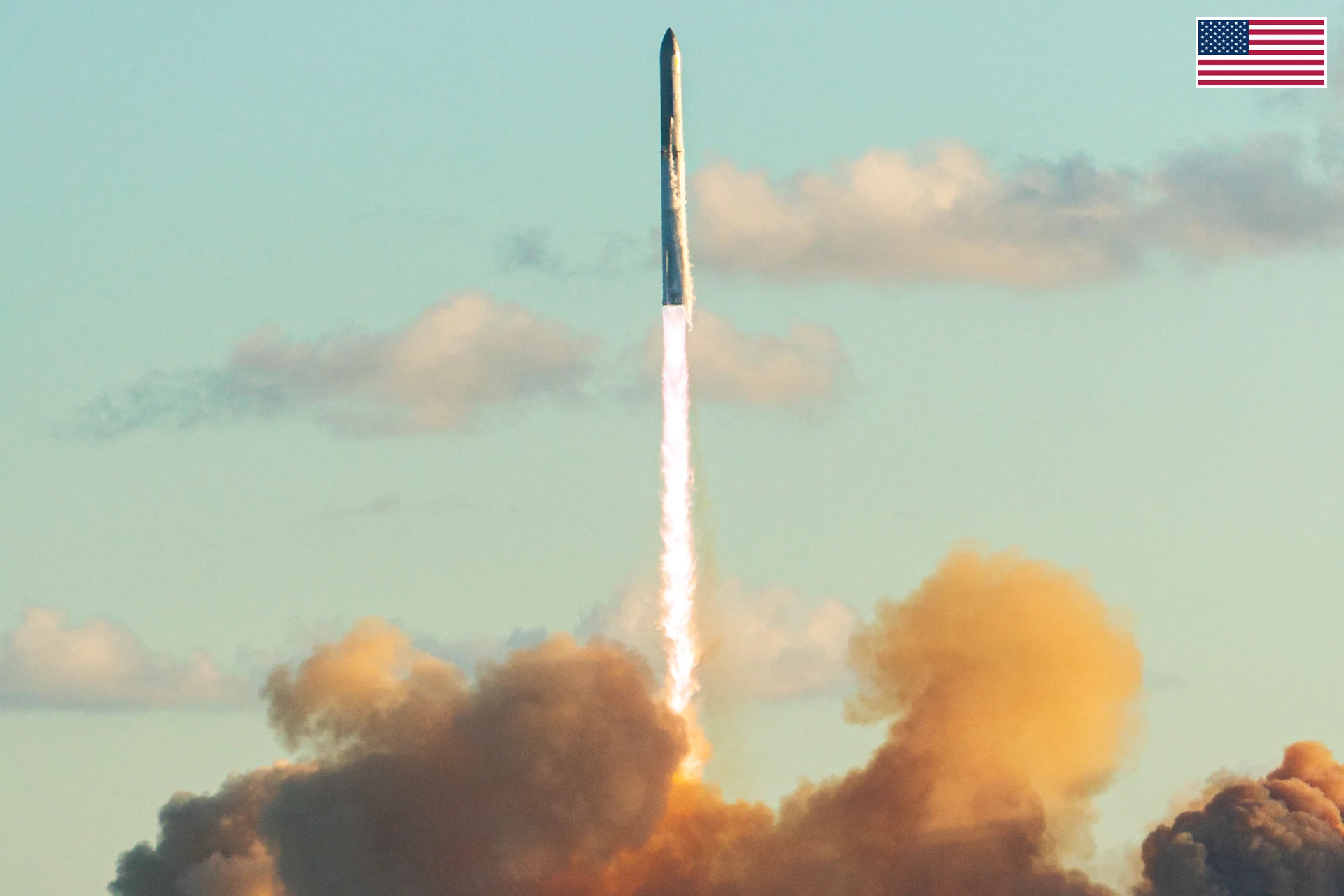
Archive photo: Starship lifts off from Starbase during flight test 11. The image shows an earlier launch, not Flight 15. Photo: Shujianyang, via Wikimedia Commons (CC BY-SA 4.0).
A 22-and-a-half-hour flight, from liftoff to the tower catch
The 124-metre-tall Starship lifted off from Starbase on Friday, November 13, at 4:47 p.m. local time (5:47 p.m. EST), powered by the 33 Raptor engines of its Super Heavy booster, according to USA Today. About two and a half minutes after launch, the upper stage ignited its six Raptor engines and separated from the booster. Starship reached orbit about 27 minutes after liftoff — only the second time the vehicle has ever done so — and then released its payload of 26 Starlink V3 satellites over about 42 minutes.
Starship then stayed in orbit for more than 20 hours while SpaceX's flight team monitored its systems and prepared for the return. Three of the 26 satellites carried cameras designed to photograph the spacecraft's heat shield from orbit, and ground-based tracking cameras assessed the condition of its protective tiles. The heat shield included improvements tested during Flight 14, among them a curved tile design across a substantial section to reduce heating in the gaps between tiles. Only after reviewing that imagery — along with the flaps, structures, guidance and navigation systems — did the team clear Starship to come home, The Statesman reported.
For the return, Starship reignited a single Raptor sea-level engine for a deorbit burn and plunged back through the atmosphere at about 17,000 miles per hour, crossing over Mexico and swinging out over the Gulf of Mexico before turning toward the Texas coast. Emerging from thick clouds, the spacecraft ignited three Raptor engines, flipped into an upright position and slowed its descent until two fittings near its upper section settled onto the launch tower's mechanical arms — nicknamed Mechazilla, or "chopsticks" — allowing the vehicle to hang above the ground. The full flight lasted 22 hours and 32 minutes, Reuters reported.
"Mechazilla catches Starship! Congratulations to the entire SpaceX team on this incredible achievement!" SpaceX said in a post on X. Chief executive Elon Musk added: "Congratulations to an incredible team at SpaceX!!!" Launch vice-president Kiko Dontchev wrote: "We did it!!!!!!"
The booster did not come back
The mission fell short of its larger goal: recovering both stages at the launch site in a single flight. The Super Heavy booster was diverted toward the Gulf of Mexico after its return manoeuvre failed to proceed as planned. According to SpaceX, the booster's boostback burn ended prematurely following a low-fuel-mass alarm, and its guidance, navigation and control system then detected that the booster was not in the correct position for a tower catch. The system triggered an automated abort, sending the booster to a designated area offshore, where it performed a landing burn before its flight termination system was activated and it exploded over the water, about six and a half minutes after liftoff.
Musk said on X that the initial reason for the diversion was that the booster was running low on fuel, but noted that flight telemetry will need to be reviewed before reaching a definite conclusion. SpaceX said the guidance system had responded as designed and that the underlying cause of the shortened boostback burn remained under investigation.
SpaceX had previously caught Super Heavy boosters with its launch towers three times — the last in March 2025 — and subsequently flew two of them again. Saturday's flight was the first attempt with the V3 booster, the production model intended for Moon and Mars work. It was also the fourth launch of Starship V3, a radically different engineering design from the first two versions of the vehicle.
Why the catch matters — and what is still missing
Until Saturday, every one of the previous 14 Starship upper stages had ended up in the ocean. A booster separates relatively early in flight, but Starship must return from orbital velocity and survive the extreme heating of atmospheric re-entry — which is why catching it is a different and harder problem. SpaceX's workhorse Falcon 9, which has launched more than 700 times since 2010, reuses its first stage but discards its upper stage into the ocean after each flight. With Starship, Musk wants a rocket system that can fly to space and back with a tempo akin to commercial airplanes, drastically cutting cost and turnaround time between launches.
The flight also advanced SpaceX's satellite business: each Starlink V3 satellite is designed to add one terabit per second of network capacity, and the company estimates the combined capacity of the 26 satellites is equivalent to about 10 Falcon 9 launches carrying the earlier Starlink V2 Mini satellites.
NASA has selected Starship as a lunar landing system for its Artemis programme, under which the spacecraft is being developed to carry astronauts to the Moon's surface. NASA administrator Jared Isaacman welcomed the catch on X: "Congrats to Elon Musk and the SpaceX team! It was almost magic... Making more believers by the day... one step closer to the moon." A modified Starship is due to launch to Earth orbit and dock with the Orion spacecraft as a test on Artemis III, planned for 2027, before a Starship Human Landing System lander carries astronauts down to the Moon on later missions. The Wire Post has previously reported on the Artemis programme's cabin-leak scare aboard Artemis II, and on Musk's admission that SpaceX throttled Starlink in Ukraine.
Despite Saturday's success, SpaceX still faces several milestones before Starship becomes fully reusable: recovering both stages in a single mission, demonstrating that a returned upper stage can be refurbished and flown again, improving heat-shield durability so it needs little or no work between flights, and demonstrating the transfer of propellant between spacecraft in orbit — a capability required for missions beyond Earth orbit, including lunar landings. The company is also preparing to launch Starship from Florida: it is finalising Pad 39A at Kennedy Space Center, expected to be ready later this month, and building two launch pads at Launch Complex 37 at Cape Canaveral Space Force Station.
What remains unconfirmed is the exact cause of the booster's failed return — SpaceX says that is still under investigation — and how much refurbishment the recovered Starship will need before it could fly again. The 15th flight test nevertheless established a new recovery capability: Starship completed an orbital mission, returned through Earth's atmosphere and was caught at the same launch site from which it had departed.