
ROME, Italy.- Italy's data protection authority has fined Meta Platforms Ireland Limited €805 million (about $887 million) for accessing the photos and videos of Italian Facebook users without their specific consent, the regulator announced on Saturday, November 14. It is by far the largest fine the authority has ever imposed, and one of the largest penalties an Italian regulator has ever handed a technology company. The fine equals roughly 0.47 percent of Meta's global turnover.
The case turns on a single Facebook feature for Android phones, "Get suggestions from gallery when browsing Facebook," which has been running since 2023. While a user browses Facebook, the feature suggests photos and videos from the phone's gallery as ideas for a post. The Garante, Italy's data protection authority, said in its decision that the Facebook app "accessed photos, videos and associated metadata stored on Italian users' smartphones without specific consent and without informing them." About 20 million Android users in Italy were affected.
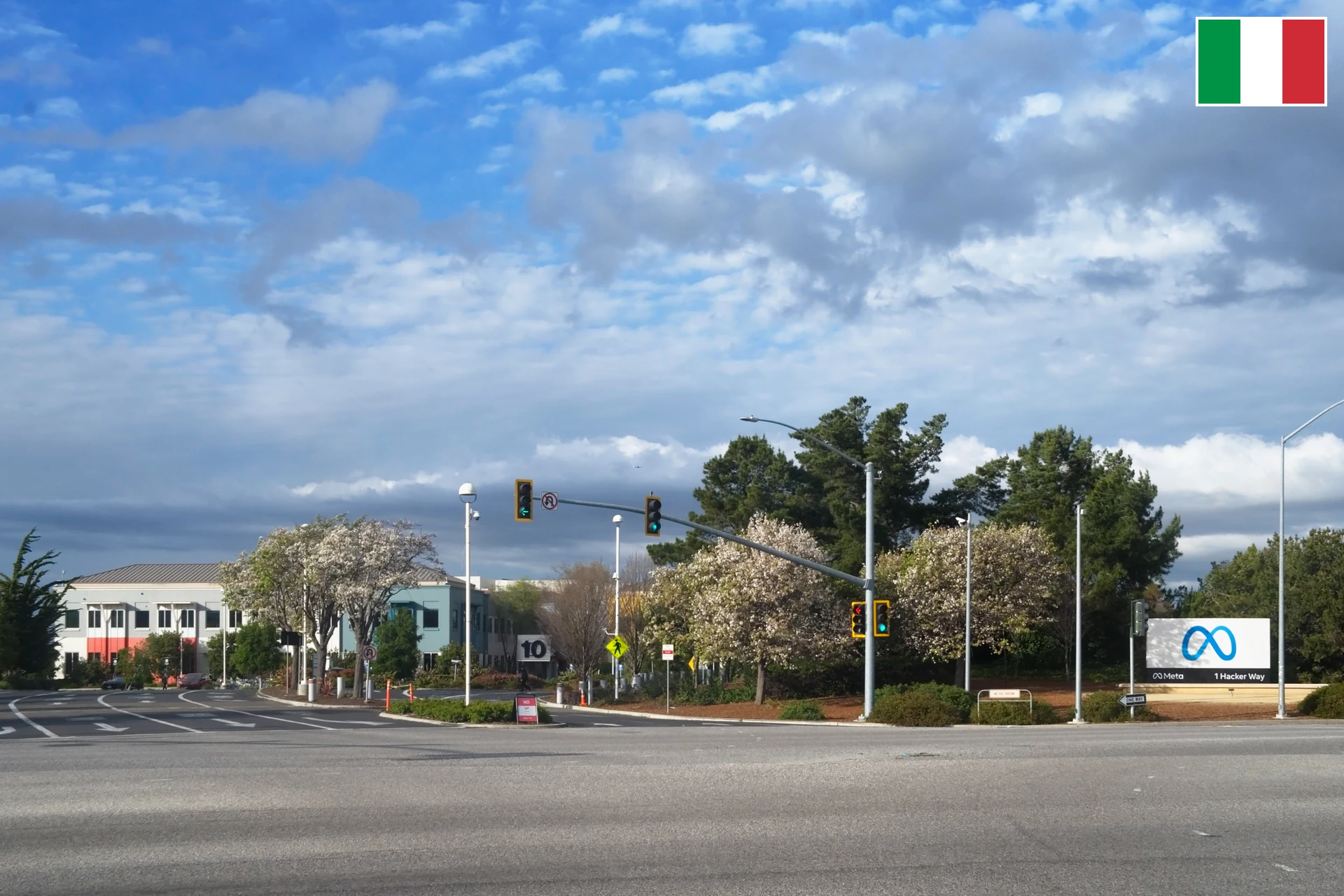
Archive photo: the entrance to Meta's headquarters complex in Menlo Park, California. The photograph was taken in March 2022 and does not show the Italian proceedings. Photo: LPS.1, via Wikimedia Commons (CC0).
One permission for the whole app
The Garante's investigation, opened in July 2025 after a complaint from the Bolzano consumer protection centre (Centro Tutela Consumatori Utenti), found three problems with how Facebook obtained access to users' galleries.
First, access to the gallery was requested through a single permission, valid for the entire app and for several functions with different needs. Second, that permission was preceded by a generic notice — "enable other features" — that did not let users understand they were also authorising gallery suggestions. Third, the feature was switched on by default.
Once granted in full, the regulator said, such a permission lets the app read the entire photo archive on the device, on an ongoing basis, "without the user, nor the Authority, being able to verify what information is actually being used."
The authority's reasoning rests on Article 122 of Italy's Privacy Code, which implements the European ePrivacy Directive. The Garante treats the smartphone as part of a person's private sphere: any access to the information it contains requires free and informed consent, regardless of whether the data is transmitted or any harm occurs. The authority also rejected Meta's argument that jurisdiction lay with the Irish regulator, because the ePrivacy rules do not provide for the "one-stop-shop" mechanism that applies under the GDPR.
Why the fine is so large
The Garante set the amount after weighing four factors: the high number of people involved, about 20 million Android users in Italy; the duration of the violation, which is still ongoing for people who have not updated the app and for those who already granted the permission; a previous decision against the company in 2019; and what the authority called Meta's limited cooperation during the investigation. Al Jazeera reported that the regulator highlighted the "lack of cooperation" and the earlier violation as contributing to the size of the fine.
The 2019 precedent shows how much the scale has changed. In June 2019 the same authority fined Facebook €1 million over the Cambridge Analytica affair, after finding that an app downloaded by 57 Italians had gathered data on 214,077 Italian users without their consent. TechCrunch reported at the time that the fine was calculated under Italy's pre-GDPR rules. Saturday's €805 million penalty is 805 times that amount, and it was set under the ePrivacy framework rather than the GDPR.
The authority did count one mitigating factor: changes Meta introduced after the complaint, which it judged late and limited to users who update the app.
What Meta must do within 60 days
The order gives Meta 60 days to fix the feature for users in Italy. The company must ask for consent through a separate, specific request for the feature, clearly explaining what it is for, that it involves access to the gallery, and how to switch it off. It must keep the feature switched off by default, even for users who have already granted gallery access. If the deadline passes without compliance, the feature cannot be switched on for users who have not given valid consent. Meta must also report to the Garante within 30 days on the steps it has started, and within 90 days on the measures adopted.
Meta says it will appeal
Meta told the BBC it plans to appeal. A company spokesperson said it "strongly disagrees" with the regulator's assessment of the facts, its application of the law, and the "disproportionate level of the fine," the BBC reported.
One question the ruling deliberately leaves open is artificial intelligence. The proceedings did not address whether gallery content was used to train AI models, a use Meta denies. The Garante said it reserves the right to assess separately a new feature, launched in 2026, that allows gallery content to be processed in the cloud — a decision that could produce a second ruling on the same part of the app.
What remains to be seen is whether Meta complies within the 60 days or whether the appeal suspends the order, and what the Garante decides about the 2026 cloud feature. Until then, the fine stands as the regulator's assessment — the largest in its history — over a feature that treated a phone's photo gallery as something Facebook could browse by default. The Wire Post has previously reported on the regulation of artificial intelligence in OpenAI's decision to train its most powerful model offline, and on the market rout that hit technology stocks in the Nasdaq's 5.5 percent plunge into correction.