
LONDON.- A British healthcare worker infected with Ebola in the Democratic Republic of the Congo (DRC) is being medically evacuated to Britain for specialist treatment, according to an official document seen by Reuters. The patient is in a stable condition and is expected to arrive in Britain on Wednesday or Thursday, November 4 or 5, 2026, before being transferred by a specialist ambulance to a high-consequence infectious disease unit, the document showed. British authorities told Reuters they did not expect the case to have a serious public health impact in Britain, and anticipated no disruption to international travel or trade.
"A British citizen currently in the DRC has tested positive for Ebola," a spokesperson for Britain's government told Reuters in an emailed statement. "The risk to the UK public from Ebola remains low." The patient, whose identity was not disclosed, had been sent to Congo by a humanitarian organisation to help support the response to the outbreak, according to the same report. The World Health Organization, asked about the patient, referred Reuters to the British authorities.
The first British case in this outbreak
It is the first case involving a British national linked to the current outbreak, although several other people from elsewhere in Europe have been infected, according to Reuters. Imported cases are rare: only four confirmed cases have been recorded in Britain since 1976, according to the UK Health Security Agency, cited by the same report. Sky News, reporting the same case, said it understood there are only two places in the UK the patient could be taken for treatment: the Royal Free Hospital in London or the Royal Victoria Infirmary in Newcastle. That detail is Sky News's understanding, not an official confirmation of the treating hospital, and neither the patient's name, age, employer nor the place in Congo where the infection occurred has been officially confirmed.
The case is not the first evacuation of a British-linked worker from this outbreak. On July 21, the UK Health Security Agency announced that a UK-resident humanitarian worker had been evacuated from the DRC as a precaution after a potential healthcare-related exposure, with no symptoms, and was isolated in a London hospital as a precaution, according to a timeline compiled from UKHSA, ECDC and LBC reports. That July case differs from this one: the worker then had no symptoms and had not tested positive; the worker now being evacuated has tested positive for Ebola.
An outbreak already past 10,000 cases
The evacuation comes from the world's second-largest Ebola outbreak on record, with more than 10,000 confirmed cases and nearly 5,000 deaths reported by late October, according to Reuters. More recent counts put the toll higher: the European Centre for Disease Prevention and Control counted 10,532 confirmed cases and 5,126 deaths as of November 2, across eight Congolese provinces, according to a live update citing ECDC figures. A November 3 report by AFP and Reuters, carried by Al Jazeera, gave a regional total of 5,376 deaths across the outbreak, of which 5,372 were in the DRC and two each in Kenya and Uganda, with approximately 10,444 infections across those three countries. The counts differ because they are dated differently and cover different geographies; this article reports each figure with its source and date rather than merging them into a single total.
The outbreak, declared on May 15, 2026, is caused by the rare Bundibugyo strain of the virus, for which there is no approved vaccine and no approved treatment, although research is ongoing. On November 4, the World Health Organization said expert groups had recommended adding two new vaccine candidates built specifically against the Bundibugyo strain, including Oxford's ChAdOx1 made with the Serum Institute of India, to the Tumaini trial in the DRC, according to Al Jazeera. It is the first time vaccines built specifically against Bundibugyo will be tested during an outbreak. On November 3, France announced 1.5 tonnes of medicine for frontline groups including ALIMA and Première Urgence Internationale, according to France Diplomatie, cited in a live update of the outbreak.
What is still to be confirmed
The immediate open questions are whether the medical evacuation lands on Wednesday or Thursday, which specialist unit receives the patient, and how the infection occurred, none of which British authorities have confirmed beyond the stable condition and the low assessed risk to the UK public. Also unconfirmed are the patient's employer and the exact location in Congo where they were working. This article will be updated when British authorities confirm the arrival and the treating hospital, or when the WHO or the Congolese health ministry publishes a new outbreak count.
Read more on The Wire Post: Ebola Death Toll in DR Congo Passes 5,000 in the Country's Deadliest Outbreak on Record and Zahoor Khan and Arabi Khan Killed Guarding Polio Workers in Mohmand Attack, Pakistan Officials Say.
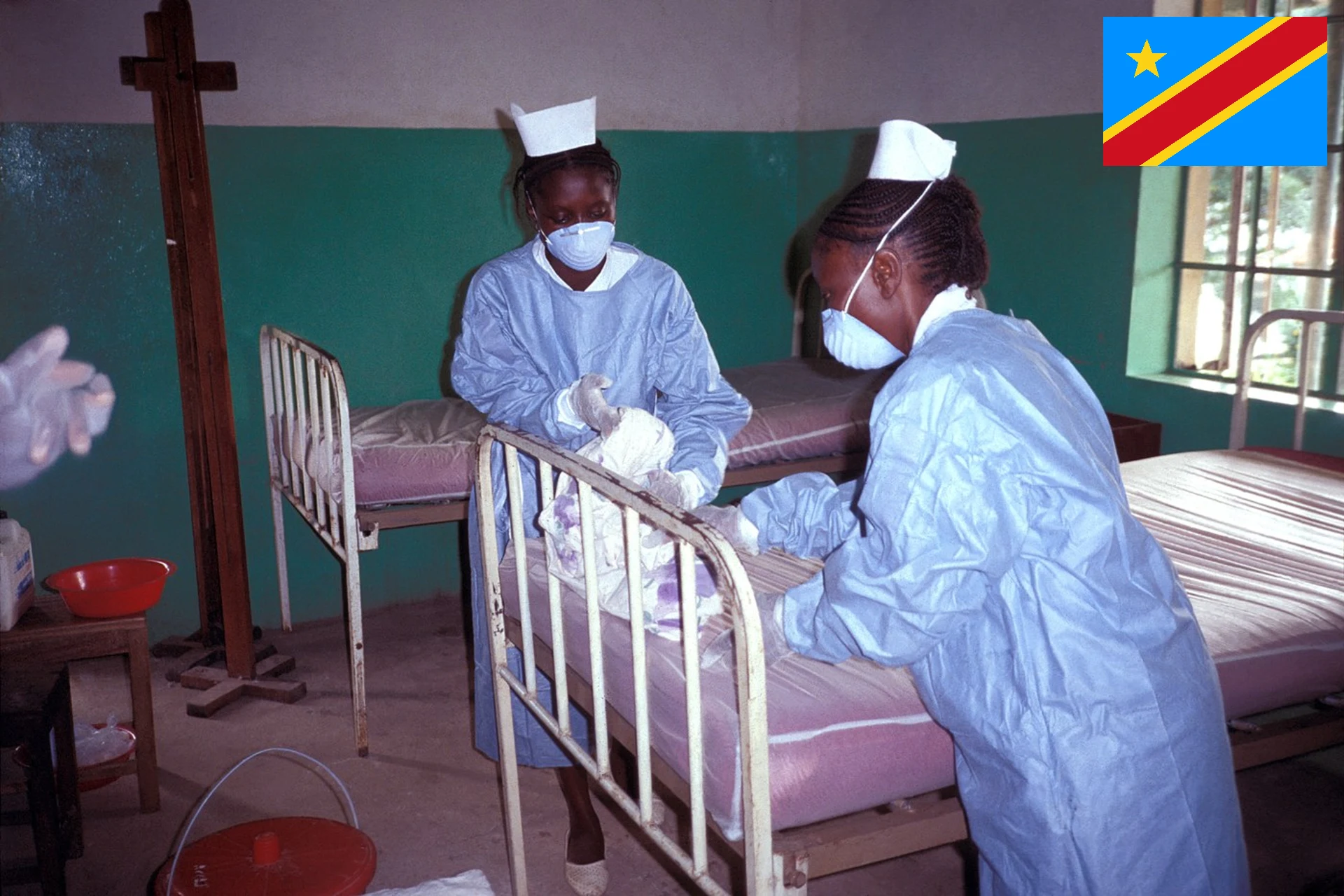
Sources: Reuters, November 4, 2026; Sky News, November 4, 2026; Al Jazeera, November 4, 2026; ECDC figures as of November 2, 2026, via live outbreak update; France Diplomatie, November 3, 2026; UK Health Security Agency, July 21, 2026. Cover photo: file photo of nurses in the Ebola isolation ward at Kikwit General Hospital, 1995 (Ethleen Lloyd/CDC, public domain, via Wikimedia Commons); it is not the patient in this story and not from the current outbreak, with a small flag of the Democratic Republic of the Congo added in the corner.