
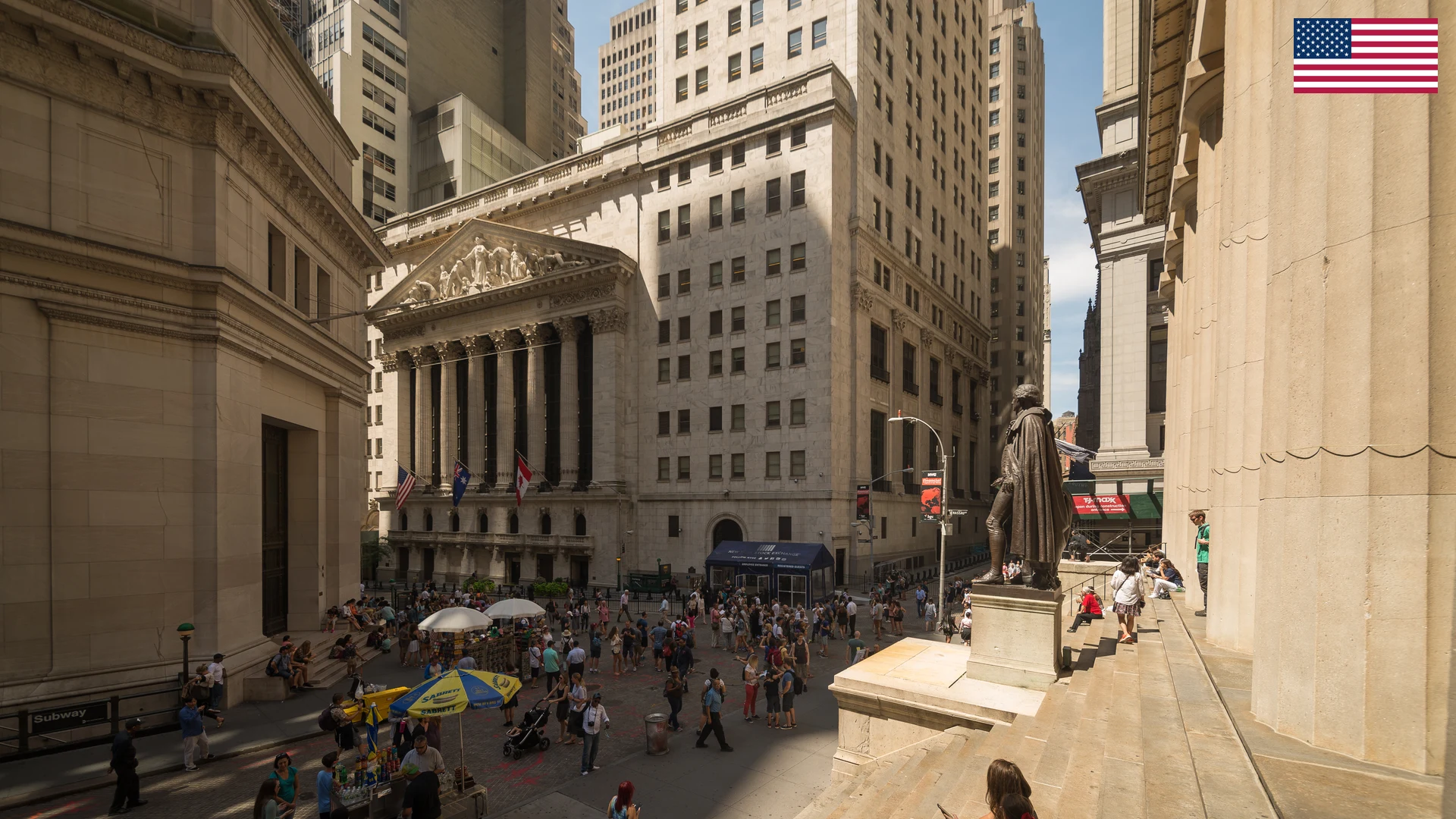
NEW YORK.- The Nasdaq Composite plunged 5.52% on Thursday, its worst day since April 2025, as chipmakers collapsed two days after Democrats won control of Congress in the midterm elections, Reuters reported. The tech-heavy index closed at 24,315.00, down 1,421.52 points, and ended more than 10% below its record high — confirming a technical correction.
The sell-off erased Wednesday's post-election rally in a single session. The S&P 500 fell 4.36%, or 334.89 points, to 7,353.73, its sharpest drop since President Donald Trump announced sweeping global tariffs in April 2025, the Associated Press reported. The Dow Jones Industrial Average lost 1,833.06 points, or 3.44%, to 51,523.06 — more than wiping out its 1,569-point jump the day before.
The fear: a slower AI buildout
Investors sold on fears that Democratic victories could bring tougher regulation that slows the construction of the data centers powering the artificial intelligence boom — the same buildout that has driven stocks to record highs this year.
Democratic wins on Tuesday, including in states where opposition to new data centers has mounted, fuelled concerns that tighter rules could slow AI infrastructure spending, Reuters reported. Texas was central to those worries: Governor-elect Gina Hinojosa campaigned on a temporary moratorium on data center construction and on ending some tax incentives for companies that build them. Wells Fargo estimates that 27% of planned U.S. data center capacity, measured in gigawatts, sits in Texas, although Republicans still control the state Legislature, which limits how far Hinojosa can change policy.
Local voters also turned against data centers. Of 41 local ballot measures in 10 states that would restrict their construction, the anti-data center side won in every case but one, in Harwood, North Dakota, CNBC reported, citing Ballotpedia. Meta President Dina Powell McCormick told a Wall Street Journal conference on Wednesday night that data center construction is going to be harder after the elections, CNBC said.
"Investors appear to be recognising that some newly elected members of Congress and governors are looking to slow the pace of AI infrastructure development," said Melissa Brown, global head of investment decision research at SimCorp. "While it seems unlikely that they will be able to stop it altogether, any slowdown would raise concerns because the AI growth story has largely depended on the rapid buildout of supporting infrastructure."
Chipmakers led the rout
The PHLX Semiconductor index collapsed 12.25% to 9,011.14, its worst day in roughly six and a half years. Micron plunged 17.46% to $656.39 and AMD fell 17.26% to $404.40. Applied Materials dropped 13.58%, Qualcomm slid 9.49% after its fiscal fourth-quarter smartphone chip sales fell short of Wall Street estimates, and Nvidia fell 9.26% to $181.60 — a slide that wiped out its gains for the year, CNN reported.
The damage spread beyond chipmakers. The narrower Nasdaq 100, home to the largest tech companies, lost 6.36% to 26,629.81, its worst day since March 2020. Meta Platforms, Amazon.com and Alphabet all fell after rallying on Wednesday. Data center operators IREN and Applied Digital, neoclouds CoreWeave and Nebius Group all tumbled, and AI-exposed utilities and equipment suppliers GE Vernova and Constellation Energy also dropped. CoreWeave fell roughly 10% and Nebius about 15%.
The Nasdaq's 1,422-point fall was its largest single-session point loss on record, surpassing the previous record of 1,122 points set on June 5, 2026, the Motley Fool reported. Wall Street's fear gauge, the VIX, posted its biggest one-day jump in almost two years, and the yield on the 10-year Treasury note dropped to 4.83%, a two-month low, as investors sought safety. Volume on U.S. exchanges was very heavy, with 26.9 billion shares traded, compared with an average of 17.7 billion over the previous 20 sessions.
"Capitulation" — but outsized
"This feels like the capitulation phase for the data center capex beneficiary stocks, especially the semiconductors," said Jed Ellerbroek, portfolio manager at Argent Capital Management. "But I think the magnitude of the moves is outsized."
Others urged calm. Truist investment chief Keith Lerner saw the week's swings as largely a knee-jerk reaction rather than a sign of how tech stocks might fare with Democrats in charge of Congress, CNN reported. Ed Yardeni, president of Yardeni Research, welcomed a slower buildout, telling CNN: "It's better to let air come out of the AI bubble than let it burst."
AI stocks have also swung for months on worries that costlier borrowing could slow data center construction. On Thursday, two regional Federal Reserve presidents, Beth Hammack of Cleveland and Thomas Barkin of Richmond, hinted at the possibility of further rate increases, and traders expected the Fed to raise rates next month after a September hike, Reuters reported.
What the drop does — and does not — change
Despite Thursday's losses, the S&P 500 remains up 7.4% in 2026, while the Nasdaq is up 4.6%. The Nasdaq closed 11.9% below its October 6 record close of 27,599.89. On Wednesday, the S&P 500 had clocked its biggest one-day percentage gain in three months, as political uncertainty eased and risk appetite returned — a rally some analysts attributed to the expectation that a divided government in Washington could lead to fewer sharp legislative changes and make it harder to agree on fiscal spending.
The sell-off spread to Asia on Thursday. South Korea's Kospi index fell 5.3%, while Samsung Electronics lost 7.5% and SK Hynix 9.5%.
Investors now turn to the government's October jobs report, due Friday. The report will be the first big test of whether Thursday's rout was a one-day repricing of the AI trade — or the start of a deeper correction.
Related coverage: Wall Street Ends a Bruising Week Lower as AI Doubts and Oil Prices Rattle Investors · Donald Trump Loses His Supreme Court Winning Streak on Elections as Justices Reject California Ballot Case in Just Six Hours
Sources: Reuters, November 5, 2026 (via The Business Times); Associated Press, November 5, 2026; CNN, November 5, 2026; CNBC/Ballotpedia; Motley Fool, November 5, 2026. All market figures reflect Thursday's close, November 5, 2026. Cover photo: The New York Stock Exchange on Wall Street, August 2017 (Arild Våg, CC BY-SA 4.0, via Wikimedia Commons), cropped to 1920x1080 with a small flag of the United States added in the top-right corner.