
KYIV, Ukraine — Ukraine struck the bridge linking Russia with occupied Crimea for a second consecutive day on Tuesday, in what Russia described as the largest Ukrainian drone attack of the war, while Russian missiles hit two of Kyiv's main bridges overnight. Two people were killed in the Crimea strike, and the Associated Press reported at least two more were killed in the Russian strikes on Kyiv.
The 19-kilometre (12-mile) road and rail bridge across the Kerch Strait is one of President Vladimir Putin's flagship projects and Russia's only direct link to the peninsula it annexed in 2014. Traffic across it was suspended after the second attack in two days, Reuters reported.
What happened on the bridge
Sergei Aksyonov, the Russian-installed governor of Crimea, said in a Telegram post that two people were killed in the latest strike and that traffic across the bridge had been suspended, Al Jazeera reported. He did not describe the damage.
Unverified video and pictures posted on social media appeared to show that the bridge's entire road arch span had collapsed into the Kerch Strait below, blocking navigation. Reuters said it could not immediately verify the footage, and the Associated Press said it could not verify reports that a span had collapsed. There was no official confirmation of the extent of the damage: the Kremlin said the first attack on Monday had caused only minor damage.
Ukrainian President Volodymyr Zelenskiy confirmed the attack on the bridge and said it was in response to Russian attacks on Ukrainian infrastructure, including bridges. "We are ... reminding Russia that war will always return to where it began," he said on X, according to Reuters.
The first strike on Monday came as Russia reported a then-record 1,336 drones downed overnight. It was the latest in a series of Ukrainian attacks on the crossing since Putin sent Russian forces into Ukraine in February 2022: a truck bomb in October 2022 killed four people and limited the bridge's capacity for several months.
Kyiv's bridges hit
Overnight, Russian forces fired ballistic missiles and drones at Kyiv, hitting two of the Ukrainian capital's main bridges and killing at least two people, the Associated Press reported.
Kyiv Mayor Vitali Klitschko said the missiles struck the capital's Northern and Southern bridges spanning the Dnipro River and partially damaged the metro system, causing power and water outages and transport restrictions. Moscow later confirmed the strikes. Al Jazeera's correspondent in Kyiv said the first of a "series of very loud explosions" rang out in the capital just before midnight.
The strikes on energy infrastructure left consumers without power in eight Ukrainian regions, Deputy Energy Minister Artem Nekrasov said: Dnipropetrovsk, Donetsk, Zaporizhzhia, Mykolaiv, Odesa, Sumy, Chernihiv and Chernivtsi. "The situation is extremely difficult in the Dnipropetrovsk and Zaporizhzhia regions. Since last week, Russia has been continuously attacking energy facilities in the Dnipro region," Nekrasov said.
Three people were injured in the Cherkasy region, local officials said, and Kharkiv, Ukraine's second-biggest city, Dnipropetrovsk and Zaporizhzhia were also targeted. Russia's Defence Ministry said on Telegram that its forces had hit transport, military and energy facilities in Kyiv, Zaporizhzhia, Cherkasy and Dnipropetrovsk, along with port infrastructure and cargo ships. Reuters said it could not immediately independently confirm those reports. Both sides deny deliberately targeting civilians.
A record drone barrage
The overnight attack on Crimea was part of what state news agencies called the largest overnight Ukrainian drone attack on Russia since the start of the full-scale war. Russia's Defence Ministry said it shot down 1,441 drones over 22 regions, surpassing the previous record of 1,336 set on Monday.
Air defences repelled a major Ukrainian drone attack on the industrial cities of Ufa and Salavat in Russia's Bashkortostan region, home to several oil refineries, state media reported, citing local officials. Moscow Mayor Sergei Sobyanin said around 800 Ukrainian drones had flown towards the surrounding Moscow region, 321 of which had been brought down en route.
Ukraine has sharply increased its strike campaign on Russian oil refineries since the end of October. Zelenskiy said on Sunday that the campaign had knocked out over half of Russia's refining capacity, a claim Reuters said it was not able to independently verify. Two industry sources told Reuters last week that the renewed campaign had reduced Russian refining capacity by about 30%. Russian officials and media have said the attacks have led to fuel shortages in at least six regions.
Why the bridge matters
The Crimea bridge was once a key supply route for Russian forces in Ukraine. It is now used mainly by residents and visitors, as the military can rely on a land corridor through Russian-controlled territory in southern Ukraine, Reuters reported. The crossing has also served as an important gateway for Russia between the Sea of Azov and the Black Sea for ships carrying grain, oil and liquefied petroleum gas, although Black Sea shipping has been severely disrupted as the drone war expanded into its waters.
The exchange of blows over bridges came as the war's diplomacy continued anyway. The attacks went on despite US-brokered peace talks in Abu Dhabi last week, the first in nine months, and separate meetings between US envoys and Putin and Zelenskiy. Kyiv and Moscow agreed on a major exchange of prisoners during last week's talks, but there was no significant breakthrough on broader issues, including territory — Russia holds about a fifth of Ukrainian land, though the front line has remained largely static for months. Those talks followed the agreement by Russia, Ukraine and the United States to resume trilateral peace talks in November.
Putin, who is due on Wednesday to start a series of meetings in China culminating in a showcase trilateral summit with US President Donald Trump and Chinese President Xi Jinping later in the week, has been informed about the attack on the bridge, the Kremlin said.
What remains to be confirmed
No official assessment of the damage to the Crimea bridge has been published, and it is not clear whether the road arch span actually collapsed, how long the crossing will stay closed, or when traffic might resume. The casualty toll in Kyiv is also preliminary: the two deaths reported by the Associated Press have not been confirmed in the Reuters or Al Jazeera accounts of the overnight strikes. And while Zelenskiy confirmed the bridge attack, neither side has published a full account of what was hit in the record drone barrage, including the refinery cities of Ufa and Salavat.
UPDATE — 17 November, 06:28 Bogotá time (11:28 UTC): Russia’s Investigative Committee said on Tuesday that the drone attacks on November 16 and 17 caused structural damage to the Crimean Bridge, and it opened a criminal case under the article on terrorist acts — the first official assessment of the extent of the damage, Türkiye Today reported, quoting the committee. Images circulating after sunrise showed the bridge’s road span destroyed, though the Russian authorities have not specified the scale of the damage. Rail traffic across the bridge has since resumed, according to TASS, via CNN, and the Moscow-backed governor Sergei Aksyonov said passengers without vehicles could use the ferry crossing; road traffic remains suspended, and wreckage from the destroyed span is blocking large vessels from reaching the Sea of Azov. Deputy Prime Minister Marat Khusnullin will chair a government commission on restoring the bridge, and President Vladimir Putin discussed the situation with Transport Minister Dmitry Yadrov. Zelenskiy, confirming the strike in a post on X, called the operation “unprecedented” and said it was the seventh stage of an operation carried out over several weeks by the Security Service of Ukraine together with the General Staff, naming Palianytsia drones, Neptune missiles, Ruta drones and FP-5 drones among the weapons used, Türkiye Today reported.
UPDATE — 17 November, 07:33 Bogotá time (12:33 UTC): The road arch has collapsed. Photos and video published on Tuesday morning show one of the bridge’s steel arches and the roadway between two supports gone, with debris in the water below, and open-source assessments put the fallen road span at about 270 metres. Ukraine’s Security Service said “one of the metal arches and the automobile span under it were completely destroyed,” the Kyiv Independent reported. Russia’s Transport Ministry confirmed that both road and rail traffic are suspended while specialists assess the damage — superseding the earlier report that rail traffic had resumed — and said there were no casualties on the bridge itself, according to preliminary information, Free Malaysia Today reported. Two people were killed elsewhere in Crimea in the overnight drone attack, the Moscow-appointed head of Crimea, Sergei Aksyonov, said. An assessment published in Kyiv put the repair at a year or longer, not months, for a fallen structure weighing some 6,000 tonnes. The rail arch was still standing in the published images, and whether the wreckage has fully blocked the navigable channel to the Sea of Azov remains unconfirmed by the Russian authorities. This update answers the open question in “What remains to be confirmed” about whether the road arch span actually collapsed: it did.
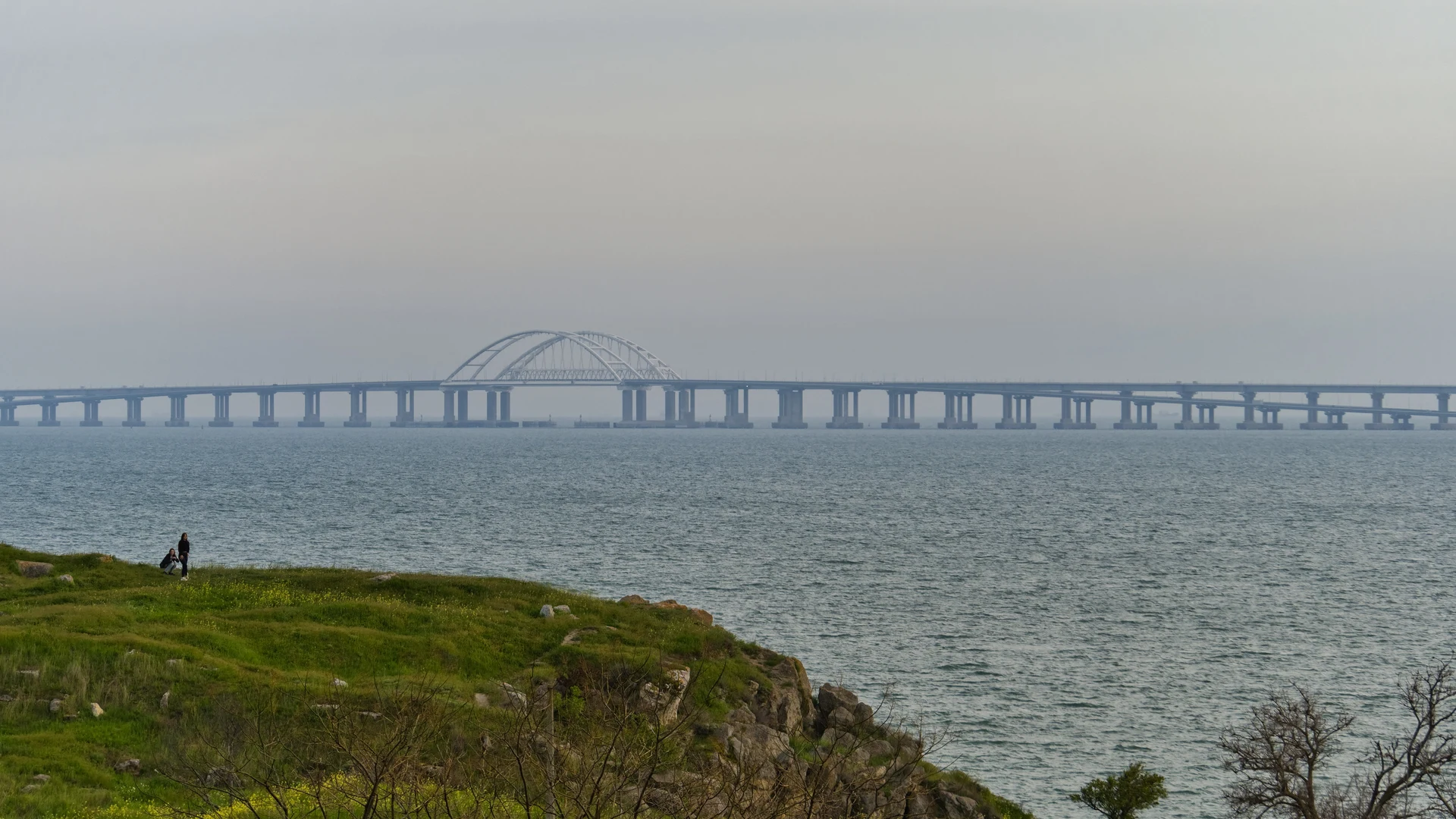
The Crimean Bridge over the Kerch Strait in May 2021. The 19-km crossing, opened by Russia after its 2014 annexation of Crimea, was struck for a second consecutive day on 17 November 2026. Photo: Alexxx1979, CC BY-SA 4.0, via Wikimedia Commons.
UPDATE — 17 November, 11:35 Bogotá time (16:35 UTC): Rail traffic across the bridge resumed on Tuesday, according to Interfax, Military.com reported. The resumption was also confirmed by Grand Service Express, the operator of railway transport to Crimea, and by Sergei Aksyonov, the Moscow-appointed head of Crimea, APA reported. The resumption applies to rail only: the road section and one of the bridge's arches remain destroyed after Tuesday's second strike, and the ferry crossing is also operating, Aksyonov said. This supersedes, for rail traffic, the morning suspension confirmed by Russia's Transport Ministry.
UPDATE — 17 November, 14:33 Bogotá time (19:33 UTC): President Volodymyr Zelenskyy said the strike was retaliation for Russian attacks on Ukrainian infrastructure — “Russia strikes our infrastructure every day, including bridges,” he wrote in a post on X — and said it followed an “unprecedented operation” that methodically destroyed Russian air defences, radar systems and electronic warfare capabilities, Reuters reported. Reuters said it could not immediately verify the footage Zelenskyy posted. Kremlin spokesman Dmitry Peskov said President Vladimir Putin had been informed about the attack; Russian investigators said the bridge’s structure had been damaged, while Peskov said a repair plan would be prepared and that the bridge would emerge stronger than before. Officials advised motorists who want to cross the Kerch Strait to use car ferries while the road section stays closed.
UPDATE — 17 November, 15:30 Bogotá time (20:30 UTC): The company that makes the Ruta cruise missiles used in the strike has given its own account of the attack. Destinus, a Dutch-headquartered defence startup, said Ukraine launched nine of its Ruta Block 1 missiles and seven hit the bridge, and its president, Oleksandr Danylyuk, told Reuters the company's systems were the only foreign-made weapons used in the operation. Danylyuk said Ukraine also used the company's Da Vinci deep-strike drones, known as the Lord, to suppress Russian air defences, Reuters reported. The company said on LinkedIn that the previous night's strikes damaged the bridge's upper load-bearing structure and that Tuesday's seven Ruta hits caused one span to collapse. The attack may also substantially delay the resumption of grain shipping from Russia's Sea of Azov, because the debris in the Kerch Strait would need to be cleared, Andrey Sizov, the head of the SovEcon consultancy, said, Bloomberg reported.
UPDATE — 17 November, 18:31 Bogotá time (23:31 UTC): Rail traffic is back, but only on one track. The first passenger train left the Russian side at 1:04 p.m. Moscow time on Tuesday, the Russian business daily Vedomosti reported, citing the Transport Ministry, Military.com reported. Sergei Aksyonov, the Russian-installed head of Crimea, said rail traffic had been restored by Tuesday afternoon and that passengers without vehicles could use a ferry, the Associated Press reported. In Brussels, Britain's Defence Secretary Wes Streeting called the strike "another example of Ukrainian ingenuity and Ukraine's absolute determination to defend itself against Russian aggression," speaking ahead of a meeting of the Ukraine Defense Contact Group, Ukrinform reported. The United Kingdom also announced £240 million ($317 million) in air-defence support for Ukraine this winter, including more than 1,000 short-range missiles and more than a dozen radars, the Associated Press reported. Not everyone expects a quick rebuild: Finnish military analyst Emil Kastehelmi wrote on X that "the road bridge won't be repaired during this war," according to Reuters, as reported by Military.com. Ukraine's General Staff said the bridges at Chonhar and Henichesk, on Crimea's northern edge, were destroyed this autumn, Ukrinform reported; Military.com said it could not independently confirm the current condition of those crossings. And the fallen road arch may have a second cost: Petro Andriushchenko, head of Ukraine's Centre for the Study of Occupation, said it had dropped into the Kerch-Yenikale Canal, blocking navigation between the Black Sea and the Sea of Azov, Nexus Europa reported. None of the reports Military.com reviewed said the channel had been formally closed.
UPDATE — 18 November, 07:32 Bogotá time (12:32 UTC): New close-up footage published on Wednesday by the Ukrainian open-source monitoring community Exilenova+, filmed from a train crossing the bridge, shows the road arch and a section of the roadway missing, with debris visible in the water below, while the railway keeps running on one track, the Kyiv Independent reported. President Volodymyr Zelensky said the strike was the final part of a seven-phase operation by Ukraine's Security Service and General Staff, carried out with a Flamingo missile. Russia's Transport Ministry said road traffic remains completely halted while trains are running on schedule, according to Interfax, Ukrainska Pravda reported.
UPDATE — 18 November, 11:34 Bogotá time (16:34 UTC): Moscow pledged to rebuild the bridge. "There is no doubt that the bridge will be restored and will be even better than before," Kremlin spokesperson Dmitry Peskov told Russian newspaper Izvestia on November 17, the Kyiv Independent reported. Russian Deputy Prime Minister Marat Khusnullin told Russian state media that officials had completed a damage assessment and determined the scope of the construction work. The military cost of the damage may be limited: most heavy traffic had already switched from the bridge to the land route through occupied southern Ukraine, Finnish analyst Emil Kastehelmi of the Black Bird Group told the Kyiv Independent. The bridge had served as an emergency route if Russia needed to move something very quickly, he said, "but of course, that option is now gone." Ukraine's General Staff, meanwhile, listed "one bridge" among Russian casualties in its morning update, a nod to the successful strike.
UPDATE — 18 November, 13:33 Bogotá time (18:33 UTC): Structural engineers say the damage to the road section is catastrophic. Colin Caprani, a professor of structural engineering at Australia's Monash University, told the BBC the main span was "completely destroyed" and that rebuilding it could prove more difficult than constructing it from scratch, with debris scattered underwater and the piers and foundations possibly damaged — some surviving sections would have to be demolished before reconstruction could even begin, the Kyiv Post reported. Ukrainian structural engineer Dmytro Makogon said: "I doubt it can be restored during the war." Retired Ukrainian Navy Captain Andrii Ryzhenko estimated that rebuilding the collapsed road section and its arch alone could take more than a year; the original 5,000-ton arch took from May 2016 to October 2017 to produce and install. The shipping stakes are now quantified: the fallen arch, weighing around 6,000 tons according to Ryzhenko, lies in the Kerch-Yenikale Canal, the only navigable route between the Sea of Azov and the Black Sea, and up to 25% of Russia's grain exports passed through it, according to Andrey Sizov of the agricultural consultancy SovEcon. Clearing the debris could take one to three months, Sizov estimated, and shipping through the strait had already been suspended since July 2026. The parallel arch supporting the railway section is still standing, although it may also have been damaged, according to the BBC.